Introduction
The urban landscape of 2026 is defined by compact living. While small apartments offer efficiency and proximity to city centers, they face a significant physical challenge during the sweltering American summer: the “Heat Trap” effect. In confined spaces, poor airflow combined with solar heat gain can turn a modern studio into an uncomfortable oven in a matter of hours.
This critical issue is a cornerstone of our comprehensive exploration in “The Ultimate Small Space Lifestyle Guide 2026: Mastering AI Tech and Modern Comfort“. While that guide provides the strategic framework for high-tech living, this article focuses on the tactical execution of climate control.
However, recent breakthroughs in residential building science—specifically Smart Ventilation—are changing how we manage indoor climates. By integrating advanced physics with smart home technology, you can achieve professional-grade cooling without the massive energy bills associated with traditional HVAC systems.
Understanding the Science of Smart Ventilation
According to the Air Infiltration and Ventilation Centre (AIVC), smart ventilation is defined as a process that continually adjusts the ventilation system in time, and optionally by location, to provide desired indoor air quality (IAQ) while minimizing energy consumption and thermal discomfort.
In a small apartment, “dumb” ventilation (simply opening a window or leaving a fan on) often works against you. If the outdoor temperature is higher than the indoor temperature, traditional ventilation actually imports heat. Smart Ventilation strategies, as detailed in research from the Lawrence Berkeley National Laboratory (LBNL), prioritize “Occupancy-Controlled” and “Outdoor Temperature-Controlled” logic. The goal is to ventilate more when it provides a thermal advantage and less when it creates a disadvantage.
The Core Concepts of Residential Cooling in 2026:
- Thermal Buffering: Utilizing the materials in your home to store “coolness” from the night.
- Demand-Controlled Ventilation (DCV): Adjusting airflow based on CO2 levels and humidity to ensure IAQ without over-ventilating.
- Solar Load Mitigation: Addressing the primary source of heat—direct sunlight—before it enters the living space.
Strategy 1: The Night-Purge Technique
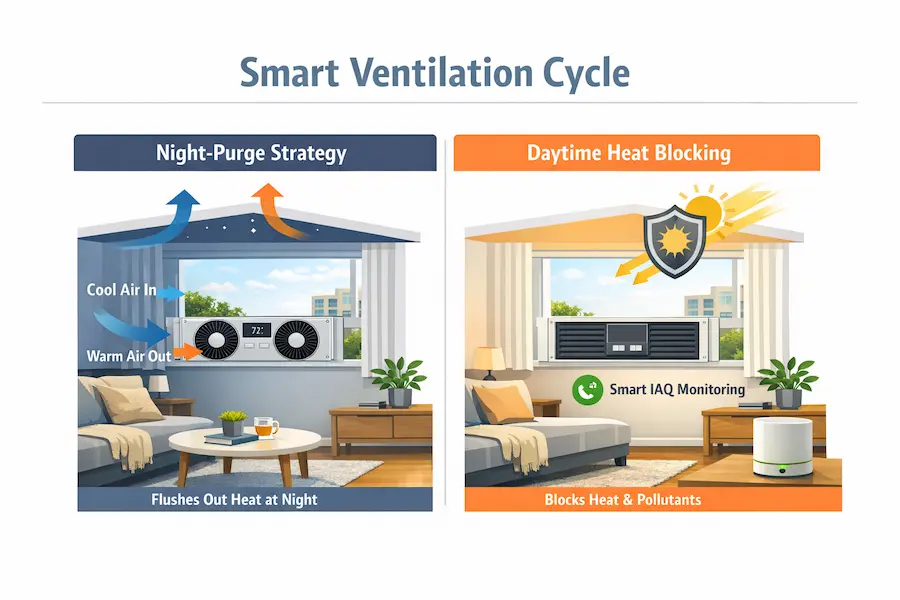
One of the most effective Smart Ventilation secrets for 2026 is the “Night-Purge.” Research indicates that increasing ventilation rates during the night when outdoor temperatures are at their lowest can significantly reduce the “peak cooling load” the following day.
For small apartments, this means using a smart sensor to detect when the outdoor air is cooler than the indoor air. At this moment, the system increases airflow to flush out the heat stored in your walls and furniture. By 8:00 AM, your apartment is a “thermal battery” of cool air, allowing you to keep windows shut and curtains drawn during the hottest parts of the day.
Strategy 2: Managing IAQ Without the Heat
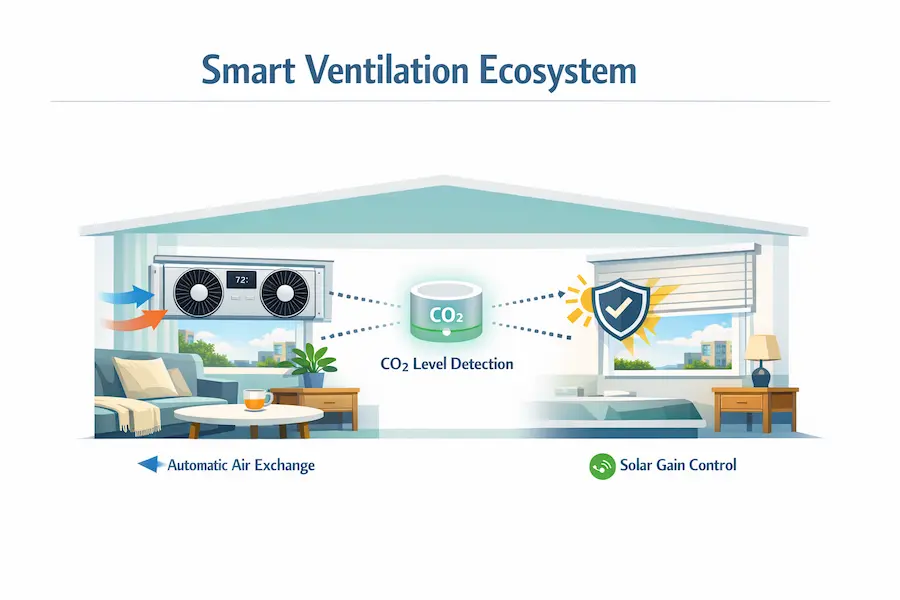
A common mistake in small spaces is over-ventilating during the day. As explored in the Guyot et al. (2017) review, smart systems use CO2 and TVOC sensors to ensure that you only breathe fresh air when needed. In a small apartment, two people can quickly increase CO2 levels.
A Smart Ventilation system in 2026 detects this rise and provides a targeted burst of fresh air, rather than a continuous stream of hot afternoon air. This “intermittent strategy” can save up to 60% in ventilation energy while maintaining superior indoor air quality compared to “dumb” base cases.
Strategy 3: The Critical Role of Solar Load Management
You cannot talk about Smart Ventilation and cooling without addressing the window. In a small apartment, the window is often the largest source of heat gain. Even the most advanced cooling system will struggle if short-wave solar radiation is allowed to hit your interior surfaces.
The secret to cooling in 2026 isn’t just about moving air; it’s about blocking the source. By using high-performance, thermal-insulated window treatments, you create a “Smart Envelope.” This allows your ventilation system to focus on air quality rather than fighting a losing battle against the sun.
Why “No-Drill” and “Automated” Solutions are the Future
For the modern renter or small-space owner, the ability to install high-performance cooling tech without permanent modifications is vital. Integration with ecosystems like Alexa, Google Home, and Apple HomeKit allows your window treatments to act as the “autonomous shutters” of your smart ventilation strategy.
Imagine your home sensing a rise in outdoor temperature and automatically lowering the blinds to 100% blackout mode before the room even begins to warm up. This is the “Smart Ventilation” advantage: proactive rather than reactive cooling.

A lifestyle image showcasing the user interface for automated home cooling. It highlights the convenience of managing smart window treatments and ventilation systems through a central hub to mitigate solar heat gain.Conclusion: The Integrated 2026 Cooling Blueprint
To survive and thrive in the upcoming summers, owners of small apartments must stop viewing cooling as just “turning on the AC.” By applying the principles of Smart Ventilation—ventilating at the right time, monitoring air quality, and aggressively blocking solar heat—you can create a sanctuary of comfort.
The science is clear: Smart Ventilation isn’t just about fans; it’s about the intelligent management of your home’s entire environment. When you combine these scientific strategies with the right tech, your small space becomes the ultimate cool retreat.
Technical References
- Gaëlle Guyot, Max Sherman, Iain Walker: A review of smart ventilation energy and IAQ performance in residential buildings
- Gaëlle Guyot, Max Sherman, Iain Walker, Jordan D. Clark: Residential smart ventilation: a review Lawrence Berkeley National Laboratory (LBNL-2001056).
- Gaëlle Guyot, Max Sherman, Iain Walker: Smart ventilation energy and indoor air quality performance in residential buildings: a review (Energy and Buildings).
- François Durier: What is smart ventilation? (AIVC) – INIVE.
Explore Smart Ventilation Solutions for Your Space
To help you implement the strategies discussed in this guide, we’ve curated a selection of innovative tools designed to optimize airflow and monitor your indoor environment. We encourage you to explore the technical details of these products to see how they might fit into your personalized cooling blueprint:
The “Night-Purge” Foundation: Comfort Zone Twin Window Fan (Reversible)
This versatile tool is ideal for executing a manual “night-purge.” With its reversible airflow function and remote control, you can explore how it helps flush out stagnant daytime heat and pull in crisp night air without the need for permanent installation. [Check Product Details & Specifications]
The Smart Tech: Super Quiet WiFi-Enabled Register Booster Fan
If you’re interested in automated climate control, this smart booster fan offers a deep dive into “Demand-Controlled Ventilation.” You can view its intelligent thermostat features and app-based controls that adjust airflow based on real-time room needs. [View Technical Features & Compatibility]
The IAQ Guardian: SunRADON lüft – Smart Indoor Air Quality Monitor
For those who prioritize data-driven comfort, this plugin monitor provides a window into your home’s health. Explore how it tracks CO2, VOCs, and temperature to provide the precise “IAQ” insights mentioned in leading smart ventilation research. [Discover More About IAQ Monitoring]