🌐 Introduction: Adaptive Flexibility and Quality of Life in Compact Spaces
In contemporary urban environments, compact living has become a defining reality. Rising density, limited land availability, and ecological pressures demand housing solutions that are not only efficient but also restorative. Here, the concept of Adaptive Flexibility emerges as a critical framework: the ability of spaces to evolve with technological advances, shifting household patterns, and human desires.
Importance of the Topic
- Adaptive Flexibility ensures that compact interiors are not static enclosures but dynamic systems capable of reconfiguration.
- Quality of Life becomes the ultimate measure of success, linking architectural adaptability to health, well‑being, and social vibrancy.
- Together, these principles redefine compact housing as an opportunity to cultivate comfort, personalization, and resilience rather than a constraint.
Core Challenges
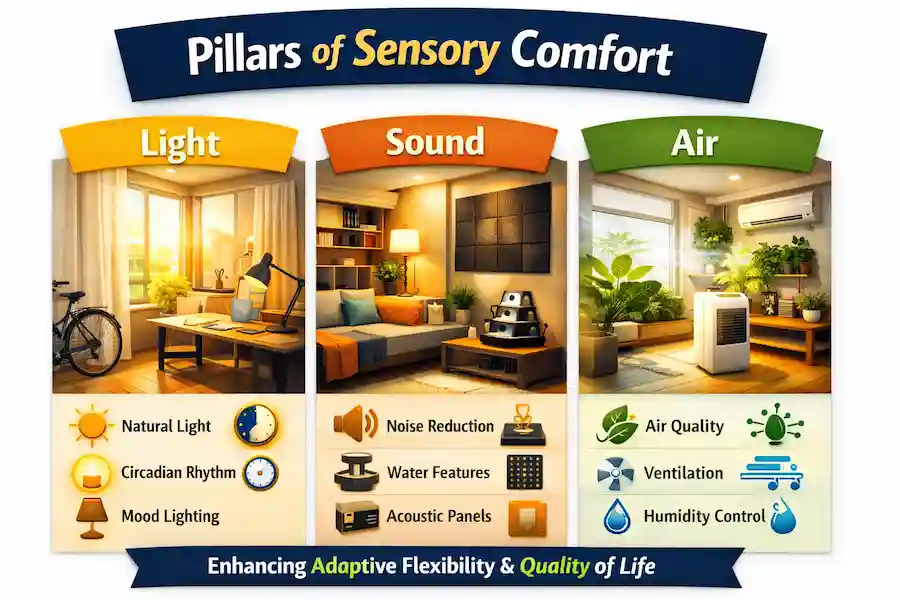
Compact spaces often face issues of noise pollution, poor ventilation, and limited daylight. Without intentional design, these factors compromise sensory comfort and reduce psychological well‑being. The challenge lies in orchestrating light, sound, and air—the three pillars of sensory comfort—so that they actively nurture health and social interaction.
Setting the Stage
This perspective connects directly to frameworks such as Human‑Centric Lighting, Engineering the Soundscape, and Engineering the Airscape. Together, they demonstrate how compact spaces can evolve with user desires, embedding Adaptive Flexibility into design and actively sustaining Quality of Life in dense urban contexts.
🏛️ Foundations of Architectural Flexibility
The idea of Adaptive Flexibility in architecture has its roots in the modern movement, where pioneers such as Walter Gropius emphasized that buildings must be capable of change to meet evolving social and technological needs. FarokhiFirouzi (2019) defines spatial flexibility as the ability to adapt conditions without altering the fundamental system, while variability refers to changes that require altering the system itself. This distinction is crucial: flexibility allows spaces to evolve seamlessly, whereas variability often demands structural intervention.
Open-plan design, enabled by steel and concrete frame structures in the late 19th century, liberated architects from rigid constraints such as fixed walls and column spacing. As Collins (1998) notes, this innovation allowed for “free plans” that became a prerequisite for flexible environments. Yet, as FarokhiFirouzi cautions, open plans alone do not guarantee true adaptability; they must be paired with intelligent organization and supportive building systems.
Building systems—lighting, acoustics, ventilation, and structural technologies—play a decisive role in achieving Adaptive Flexibility. Koolhaas (1995) argued that advanced systems can enhance spatial adaptability, but they must not compromise spatial quality. Effective integration of these systems ensures that compact spaces remain functional, resilient, and capable of supporting diverse user needs, as highlighted in ArchDaily, which showcases global practices in adaptive and sustainable architectural design.
Ultimately, the foundation of Adaptive Flexibility lies in balancing openness with performance. Open plans provide the canvas, but it is the careful orchestration of systems and spatial organization that transforms compact housing into environments that actively sustain Quality of Life. By distinguishing flexibility from variability and leveraging structural innovations, architects create spaces that are not static containers but dynamic frameworks for human well-being.
Comparative Strategies in Architectural Flexibility
| Approach | Key Features | Impact on Adaptive Flexibility | Contribution to Quality of Life |
|---|---|---|---|
| Open Plan Design | Steel and concrete frames enabled “free plans” with fewer structural constraints (Collins, 1998). | Provides baseline adaptability by removing rigid partitions, but requires additional systems for true flexibility. | Enhances spatial perception and daylight, but risks inefficiency if not paired with functional zoning. |
| Modular Systems | Prefabricated, interchangeable components (Meudon House, SIRA project). | Allows rapid reconfiguration and scalability, supporting long-term adaptability. | Improves usability in compact housing by enabling spaces to evolve with household needs. |
| Organized Spaces | Minimization of fixed-use areas, maximizing free space (Hertzberger). | Strengthens Adaptive Flexibility by giving users interpretive control over space. | Supports psychological comfort by allowing personalization and multi-functionality. |
| Smart Furniture | Transformable walls, ceiling-mounted beds, sensor-driven layouts (Goessler & Kaluarachchi, 2023). | Real-time adaptability through automation and AI, doubling or tripling functional capacity. | Directly enhances Quality of Life by integrating personalization, efficiency, and comfort. |
| Micro-Environmental Design | Leveraging variations in light, humidity, and airflow (Denney et al., 2020). | Complements architectural strategies by buffering stressors and sustaining health. | Ensures compact spaces remain restorative, linking environmental awareness to Quality of Life. |
This table shows how the evolution from open plans to smart adaptive systems reflects a shift from structural liberation to technological integration. The consistent thread is that Adaptive Flexibility is inseparable from Quality of Life: both depend on balancing openness, modularity, and environmental responsiveness with user-centered design.
🏠 Adaptive Compact Housing under Spatial Scarcity
Compact housing has become a central theme in contemporary urban design, especially under conditions of land scarcity and rising population density. Within the framework of Adaptive Flexibility, housing is no longer treated as a fixed typology but as a dynamic system that evolves with shifting household patterns, technological advances, and ecological pressures. This adaptability is essential to sustaining Quality of Life in small urban environments where space is limited but human needs remain diverse.
Spatial Configuration and Usability
Tafahomi’s MiniVilla study demonstrates that conventional fixed layouts are insufficient for long-term usability in compact dwellings. Instead, spatial systems must allow reconfiguration to accommodate hybrid living and working patterns, changing household compositions, and psychological needs such as privacy and daylight access. By embedding Adaptive Flexibility into spatial organization, compact housing can transform from restrictive interiors into restorative environments that actively nurture Quality of Life.
Material Performance and Environmental Integration
Material choices are not only technical but experiential. The EPA’s guidance on Air Cleaners and Filters highlights how filtration systems improve indoor air quality, while Tafahomi’s findings show that perceived tactility and aging behavior of materials significantly influence user satisfaction. In compact spaces, façades and interiors must balance durability, acoustic absorption, and environmental responsiveness. This integration ensures that Adaptive Flexibility extends beyond layout to include sensory and environmental comfort, reinforcing Quality of Life.
Functional Units: Kitchens, Washing, and Sleeping
Critical domains such as kitchens, washing facilities, and sleeping arrangements require modular, flexible solutions. Traditional static layouts are increasingly incompatible with evolving technologies and lifestyles. Modular units capable of adapting to different appliance configurations and usage patterns embody Adaptive Flexibility, allowing compact housing to remain viable and socially vibrant. These adaptive units directly support Quality of Life by aligning domestic routines with contemporary needs.
🤖 Smart Adaptive Homes and Interactive Architecture
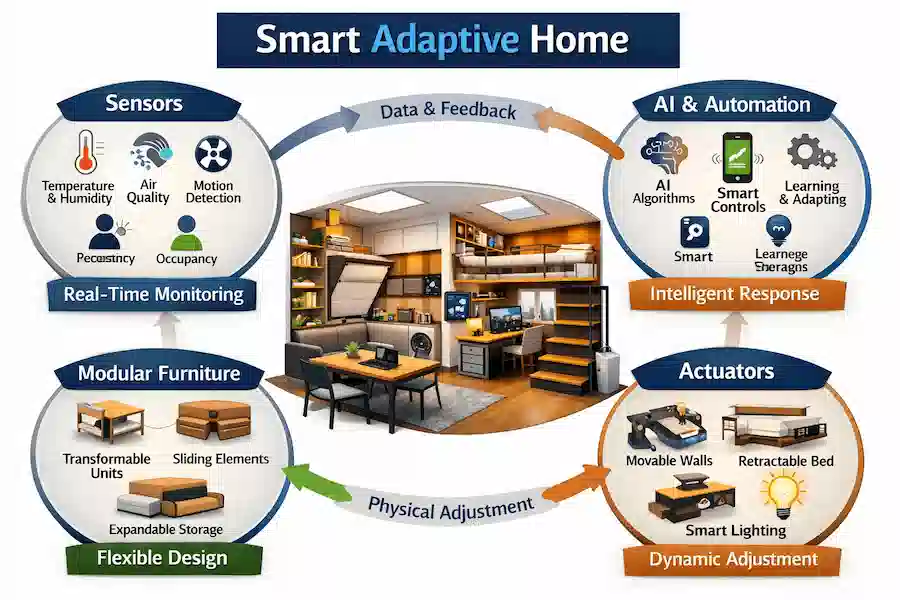
Smart adaptive homes represent the next evolution of Adaptive Flexibility, merging architectural design with intelligent technologies to create living environments that respond dynamically to user needs. As Goessler and Kaluarachchi (2023) demonstrate, the integration of sensors, actuators, and artificial intelligence transforms compact dwellings into interactive systems capable of real-time adaptation. This convergence of architecture and technology directly enhances Quality of Life, allowing spaces to anticipate, learn, and adjust to human behavior rather than merely accommodate it.
Intelligent Systems and Real-Time Adaptation
Within the framework of Interactive Architecture, smart homes employ networks of sensors and actuators to monitor environmental conditions—temperature, humidity, air quality, and occupancy—and respond instantly. These systems embody Adaptive Flexibility by enabling spaces to shift functions throughout the day: a living room becomes a workspace, a bedroom transforms into a social zone. The MIT CityHome project and Ori Living’s transformable furniture exemplify this principle, showing how automation can double or even triple the functional capacity of small apartments while maintaining comfort and efficiency.
Human-Centric Interaction and Ambient Intelligence
Goessler and Kaluarachchi’s review highlights the role of Ambient Intelligence, where technology blends seamlessly into the environment. Smart lighting adjusts to circadian rhythms, air purifiers respond to pollutant levels, and movable partitions reconfigure automatically based on occupancy. This invisible layer of intelligence ensures that Quality of Life is supported through personalized environmental control, reducing stress and enhancing well-being. The home becomes a responsive organism—learning from user patterns and optimizing conditions for health, productivity, and relaxation.
Architectural Integration and Design Implications
Adaptive architecture extends beyond gadgets; it redefines spatial logic. Modular walls, retractable furniture, and kinetic façades embody Adaptive Flexibility by merging mechanical precision with aesthetic coherence. The Muscle Project at TU Delft and the RoomShift prototype demonstrate how robotics and responsive materials can reshape interiors in real time. These innovations illustrate that smart adaptive homes are not futuristic fantasies but practical solutions to spatial scarcity, sustainability, and human comfort.
🌿 Micro-Environmental Variation and Sensory Comfort
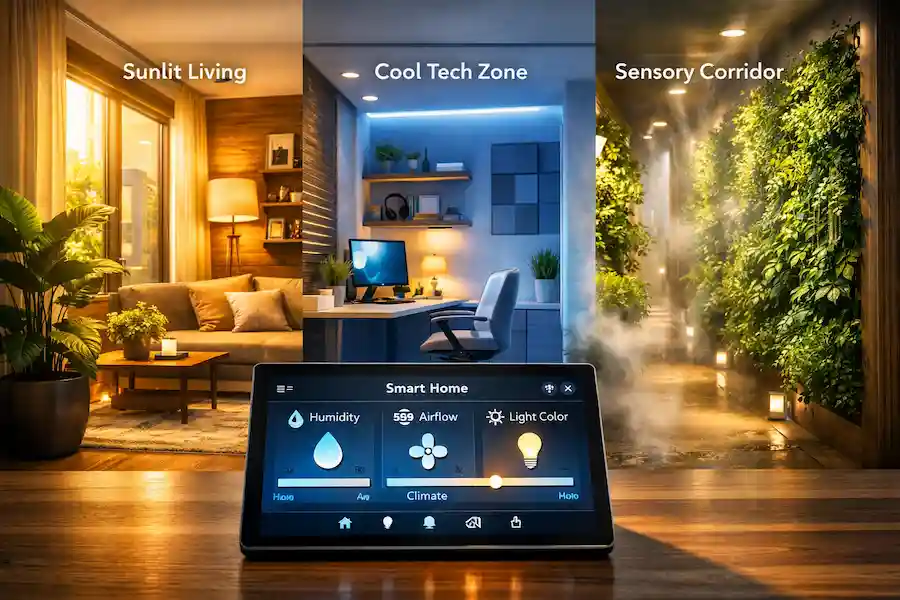
Micro-environmental variation plays a decisive role in shaping Adaptive Flexibility and Quality of Life within compact urban spaces. Drawing on Denney et al. (2020), small-scale differences in temperature, humidity, airflow, and light intensity—often overlooked in architectural design—can profoundly influence physiological comfort and psychological well-being. These micro‑conditions act as invisible layers of design, buffering occupants against environmental stressors and enhancing sensory balance.
Fine-Grained Environmental Dynamics
Within the framework of Engineering the Soundscape, micro‑environments are not static backdrops but dynamic systems that interact with sound, light, and air. Denney’s research shows that even within a few meters, soil moisture, air temperature, and radiation levels can vary significantly, creating microhabitats that sustain life and comfort. Translating this to architecture, such variation can be harnessed through materials, vegetation, and façade geometry to moderate acoustics and thermal conditions—key components of Adaptive Flexibility.
Sensory Comfort in Compact Spaces
In small dwellings or urban courtyards, micro‑environmental design ensures that sensory comfort is achieved through subtle modulation rather than large-scale intervention. Green façades, water features, and porous materials diffuse sound and regulate humidity, while cross‑ventilation and daylight gradients maintain equilibrium. These strategies transform confined interiors into restorative environments, directly supporting Quality of Life by reducing fatigue, improving air quality, and fostering psychological calm.
Integrating Micro‑Variation into Design
| Design Element | Micro‑Environmental Function | Impact on Adaptive Flexibility | Contribution to Quality of Life |
|---|---|---|---|
| Vegetation and Green Walls | Regulate humidity and absorb noise | Natural adaptability to climate shifts | Enhances relaxation and acoustic balance |
| Water Features | Evaporative cooling and sound masking | Dynamic thermal control | Promotes calm and sensory diversity |
| Perforated Façades | Diffuse light and scatter sound | Adjustable environmental permeability | Reduces glare and noise fatigue |
| Smart Ventilation | Responds to CO₂ and humidity levels | Real‑time environmental adaptation | Improves health and cognitive performance |
🔄 Design Strategies for Evolving Spaces
Across the reviewed literature, several strategies converge to show how compact housing can evolve dynamically rather than remain static. These strategies embody Adaptive Flexibility and directly sustain Quality of Life in dense urban environments.
Modular Systems
Modular systems allow interchangeable components that can be assembled, disassembled, or reconfigured depending on household needs. Prefabricated panels and modular kitchens exemplify this approach, enabling rapid adaptation without costly renovations.
Smart Furniture
Smart furniture integrates automation and transformable design. Examples include retractable beds, sliding walls, and multi‑functional desks. These systems expand usable space two to three times, as highlighted in Goessler & Kaluarachchi’s review, and reinforce personalization as a key dimension of Quality of Life.
Spatial Reorganization
Spatial reorganization minimizes fixed‑use areas and maximizes user choice. Movable partitions, lofted sleeping zones, and flexible circulation patterns allow interiors to shift between private and communal functions, sustaining comfort and autonomy.
Micro‑Environmental Design
Micro‑environmental design leverages natural variation—light, airflow, humidity, and greenery—to buffer stressors and enhance sensory comfort. Denney et al. (2020) show that micro‑habitats can mitigate fatigue and improve restoration, proving that environmental intelligence is inseparable from Adaptive Flexibility.
🌍 Quality of Life in Compact Urban Environments
Compact spaces are often perceived as restrictive, yet when designed with Adaptive Flexibility, they become restorative environments that actively nurture well‑being. Within the framework of Engineering the Soundscape, light, sound, and air are orchestrated to create sensory balance, while smart systems ensure personalization and efficiency.
Orchestrating the Pillars of Comfort
- Light: Human‑centric lighting strategies regulate circadian rhythms, reduce fatigue, and enhance productivity.
- Sound: Acoustic comfort mitigates harmful noise while introducing positive auditory cues such as water features or greenery.
- Air: Smart ventilation and filtration systems maintain healthy indoor air quality, directly supporting cognitive clarity and relaxation.
Smart Systems and Personalization
Automation and ambient intelligence allow interiors to adapt in real time. Sensors monitor occupancy, CO₂ levels, and humidity, while actuators adjust lighting, airflow, and movable partitions. This responsiveness embodies Adaptive Flexibility, ensuring that compact homes evolve with user desires rather than constrain them.
📚 Conclusion and Future Directions
The reviewed literature demonstrates that Adaptive Flexibility is inseparable from Quality of Life in compact urban environments. From modular systems and spatial reorganization to smart adaptive homes and micro‑environmental design, each strategy contributes to transforming limited square footage into restorative, human‑centered habitats.
Future directions should focus on:
- AI‑driven ventilation and air quality monitoring to sustain health in dense housing.
- Smart furniture integration that expands functional capacity without increasing footprint.
- Micro‑environmental modeling to buffer stressors and enhance sensory comfort.
- Cross‑disciplinary design combining architecture, ecology, and technology to create resilient urban living systems.
Ultimately, compact spaces are not constraints but opportunities. By embedding Adaptive Flexibility into design, architects and engineers can cultivate environments that actively sustain Quality of Life, ensuring that small urban dwellings evolve with user desires, ecological pressures, and technological innovation. This vision resonates with the principles outlined in The Philosophy of Quality of Life in Small Spaces: The 7 Pillars of a More Comfortable Life, which frames compact housing not merely as a technical challenge but as a holistic pursuit of well‑being through design.
📖 References
- FarokhiFirouzi, H. (2019). A Review on Flexibility in Architectural Design. International Transaction Journal of Engineering, Management, & Applied Sciences & Technologies, 10(6), 779–786.
- Tafahomi, M. (2026). Architecture as a Way of Life: A Practice‑Based Study on Adaptive Compact Housing under Conditions of Spatial Scarcity. International Journal of Engineering Research and Development, 22(2), 82–83.
- Goessler, T., & Kaluarachchi, Y. (2023). Smart Adaptive Homes and Their Potential to Improve Space Efficiency and Personalisation. Buildings, 13(1132).
- Denney, D. A., Jameel, M. I., Bemmels, J. B., Rochford, M. E., & Anderson, J. T. (2020). Small Spaces, Big Impacts: Contributions of Micro‑Environmental Variation to Population Persistence under Climate Change. AoB Plants, 12(2), plaa005.
- U.S. Environmental Protection Agency (EPA). Air Cleaners and Air Filters in the Home. EPA Indoor Air Quality Guidance.