
Introduction
Sensory comfort refers to the holistic experience of well-being in a space, shaped by the interplay of acoustic, visual, and social factors. In the context of urban design, it is closely connected to acoustics, since sound is one of the most immediate and unavoidable elements of human perception. Within the framework of Engineering the Soundscape, sensory comfort is not achieved by eliminating sound altogether, but by orchestrating auditory environments that are restorative, inclusive, and socially vibrant.
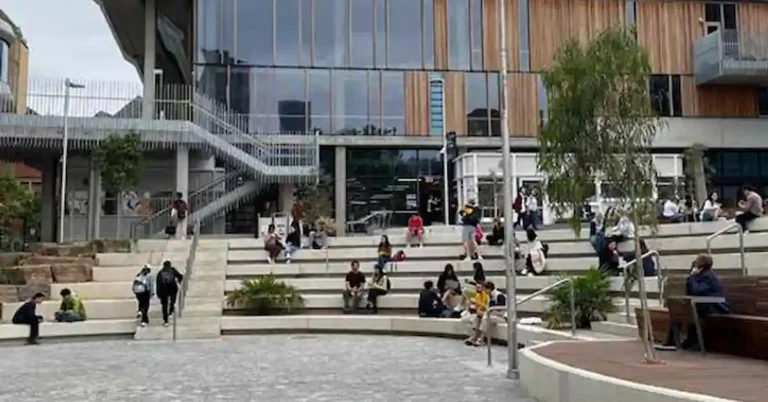
The importance of compact urban spaces in modern cities cannot be overstated. As urban populations continue to grow, plazas, courtyards, and pocket parks serve as vital areas for relaxation, social interaction, and cultural identity. These spaces are often surrounded by dense building façades and busy traffic corridors, making them highly susceptible to noise pollution. Without careful design, such environments can become stressful and alienating, undermining both physical and psychological well-being. By applying Engineering the Soundscape, architects and planners can transform compact spaces into havens of tranquility and community engagement.
Noise pollution remains one of the most pressing challenges in urban life. The World Health Organization has identified environmental noise as a major public health risk, linking it to cardiovascular disease, sleep disturbance, and cognitive impairment. Traditional noise control strategies—focused solely on reducing decibel levels—often fail to address the qualitative dimensions of sound. In contrast, the soundscape approach emphasizes perception, treating sounds as resources that can enrich urban life. By integrating acoustic design solutions into compact urban spaces, Engineering the Soundscape offers a pathway to healthier, more resilient cities where sensory comfort is prioritized alongside visual and social dimensions.
1. Theoretical Framework
The concept of Soundscape has been formally defined by ISO 12913 as “the acoustic environment as perceived or understood in context.” This definition emphasizes perception rather than purely physical measurements, highlighting that sound is not just a technical phenomenon but a lived experience. Within the framework of Engineering the Soundscape, this perspective shifts the focus from noise reduction alone to the holistic design of auditory environments that support human well-being.
Traditional noise control strategies have historically treated sound as waste, aiming to suppress or eliminate it through barriers, insulation, or zoning. While effective in reducing decibel levels, such approaches often neglect the qualitative dimensions of sound. In contrast, the soundscape approach—central to Engineering the Soundscape—considers sounds as resources that can enrich urban life. Pleasant auditory cues such as water features, birdsong, or human laughter are integrated intentionally into design, creating environments that are not only quieter but also more engaging and restorative.
The impact of acoustics on psychological and social well-being is well documented. WHO guidelines recognize environmental noise as one of the top public health risks, linking prolonged exposure to cardiovascular disease, sleep disturbance, and cognitive impairment. Jian Kang’s studies further demonstrate that thoughtfully designed soundscapes can foster relaxation, communication, and social interaction, reinforcing the idea that Engineering the Soundscape is inseparable from promoting mental health and community cohesion. By reframing acoustics as a design resource, architects and planners can create compact urban spaces that balance stimulation and tranquility, ultimately enhancing sensory comfort and quality of life.
Comparative Framework
| Aspect | Traditional Noise Control | Soundscape Approach (Engineering the Soundscape) |
|---|---|---|
| Core Philosophy | Treats sound as waste to be eliminated. | Views sound as a resource to be designed and integrated. |
| Primary Goal | Reduce decibel levels through barriers, insulation, and zoning. | Enhance sensory comfort by shaping auditory experiences in context. |
| Design Focus | Focuses on suppression of unwanted noise only. | Balances unwanted and wanted sounds, creating environments that are restorative and socially engaging. |
| Methods | Technical solutions: walls, glazing, insulation, and distance from sources. | Holistic strategies: façades with absorptive materials, vegetation, water features, and spatial geometry. |
| Human Experience | Often ignores perception, leading to sterile or monotonous environments. | Prioritizes perception, recognizing that pleasant sounds (laughter, music, birdsong) enrich urban life. |
| Health Impact | Reduces exposure but may not address psychological needs. | Supports mental health and social well-being (WHO guidelines, Jian Kang’s studies). |
| Urban Application | Limited to noise reduction metrics. | Applied in plazas, courtyards, and compact spaces to foster community and identity. |
2. Factors Influencing Sensory Comfort
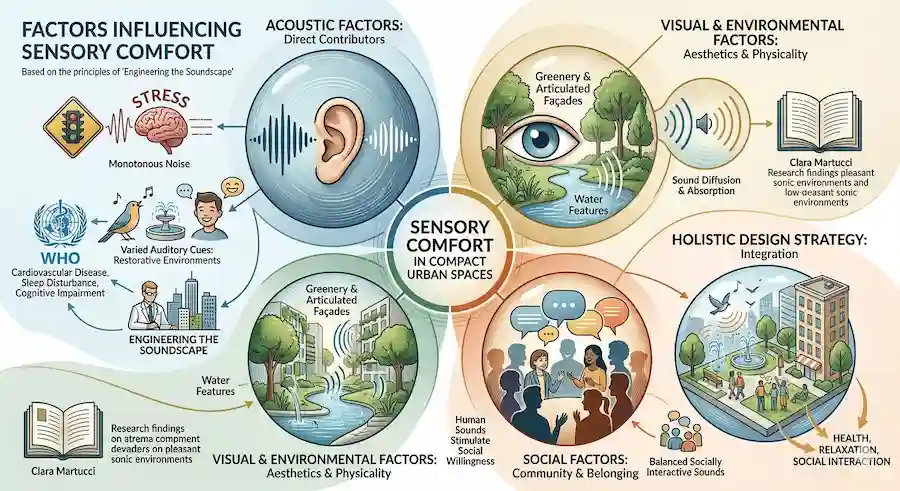
Sensory comfort in compact urban spaces is shaped by a combination of acoustic, visual, environmental, and social factors. Within the framework of Engineering the Soundscape, these elements interact to determine how people perceive and experience a space, influencing both psychological well-being and social behavior.
Acoustic factors are the most direct contributors. Noise levels, diversity of sounds, and the balance between natural and artificial sources all affect comfort. Studies show that monotonous traffic noise leads to stress and fatigue, while varied auditory cues—such as birdsong, fountains, or human laughter—create restorative environments. The World Health Organization has emphasized that prolonged exposure to environmental noise is a major public health risk, linking it to cardiovascular disease, sleep disturbance, and cognitive impairment. By applying Engineering the Soundscape, designers can mitigate harmful noise while enhancing positive auditory experiences.
Visual and environmental factors also play a critical role. Greenery, water features, and material choices in façades influence how sound is absorbed or reflected, while simultaneously shaping the aesthetic and sensory qualities of a space. Clara Martucci’s research highlights how articulated façades and vegetation diffuse sound, creating more pleasant sonic environments.
Social factors are equally important. Jingwen Cao’s studies demonstrate that human sounds—conversation, laughter, and event noise—stimulate social willingness, though they must be balanced with suitability to avoid overwhelming the space. In compact plazas, the right mix of socially interactive sounds fosters community identity and belonging.
Ultimately, Engineering the Soundscape requires integrating these acoustic, visual, and social dimensions into a holistic design strategy. Sensory comfort is not achieved by eliminating sound, but by orchestrating it in ways that support health, relaxation, and social interaction.
3. Factors Influencing Sensory Comfort
Sensory comfort in compact urban spaces is shaped by multiple dimensions that interact to influence how people perceive and use the built environment. Within the framework of Engineering the Soundscape, these dimensions—acoustic, visual/environmental, and social—must be considered together to create spaces that are restorative, inclusive, and socially vibrant.
Acoustic factors are the most immediate contributors. Noise levels, auditory diversity, and the balance between natural and artificial sounds determine whether a space feels oppressive or inviting. Research from WHO highlights that prolonged exposure to traffic noise can lead to cardiovascular disease, sleep disturbance, and cognitive impairment. Conversely, auditory diversity—such as birdsong, fountains, or human laughter—creates variation that reduces monotony and enhances well-being. By applying Engineering the Soundscape, designers can mitigate harmful noise while intentionally introducing positive auditory cues that enrich the urban experience.
Visual and environmental factors also play a crucial role. Greenery, water features, and architectural materials influence both the absorption and reflection of sound, while simultaneously shaping the sensory qualities of a space. Clara Martucci’s comparative studies show that articulated façades and vegetation diffuse sound, softening harsh noise and creating more pleasant sonic atmospheres. In compact plazas, the integration of natural elements not only improves acoustics but also provides psychological restoration.
Social factors are equally significant. Jingwen Cao’s research demonstrates that usage patterns and social relationships affect how soundscapes are evaluated. Human sounds—conversation, laughter, and event noise—stimulate social willingness, encouraging interaction and community identity. However, these sounds must be balanced with suitability to avoid overwhelming the space. Within Engineering the Soundscape, this balance ensures that compact urban areas foster both stimulation and tranquility.
Ultimately, sensory comfort emerges from the interplay of these factors. Engineering the Soundscape reframes acoustics as a design resource, orchestrating sound, sight, and social interaction to create environments that support health, relaxation, and community cohesion.

4. Façade Engineering
Façades play a critical role in shaping the acoustic environment of compact urban spaces. Within the framework of Engineering the Soundscape, building skins are not merely visual boundaries but active acoustic surfaces that absorb, reflect, or scatter sound. Their materiality and geometry directly influence how noise penetrates or dissipates in public squares, courtyards, and streets.
The role of façades in absorbing sound is particularly important in dense urban areas. Materials such as acoustic panels, perforated surfaces, or vegetation integrated into façades can reduce reverberation and soften harsh noise. Conversely, reflective façades—often made of glass, steel, or smooth concrete—can amplify traffic noise, creating uncomfortable environments. Scattering surfaces, such as articulated stone façades or ornamented historic walls, diffuse sound in multiple directions, reducing intensity and enhancing auditory diversity. This balance between absorption, reflection, and scattering is central to Engineering the Soundscape.
Case studies illustrate these principles. At Central St. Giles in London, Renzo Piano’s colorful glass façades were analyzed for their acoustic impact. Research showed that reflective surfaces increased reverberation, while introducing absorptive materials at ground level significantly reduced noise ingress. In Vicenza, Italy, historic façades with arches, balconies, and cornices demonstrate how geometric articulation diffuses sound, creating intimate and socially vibrant plazas. These examples highlight how façade design can either exacerbate or mitigate noise pollution.
Modern techniques expand these possibilities. Sound-absorbing materials, such as Class A acoustic panels, can be integrated into façades without compromising aesthetics. Geometric articulation—through angled surfaces, perforated panels, or convex forms—scatters sound, reducing direct noise exposure. By combining traditional craftsmanship with contemporary materials, architects can achieve façades that are both visually striking and acoustically effective.
Ultimately, Engineering the Soundscape through façade design transforms buildings into active participants in urban acoustics. Rather than passive barriers, façades become tools for creating sensory comfort, fostering social interaction, and enhancing the quality of life in compact urban spaces.
5. Social Comfort and Soundscapes
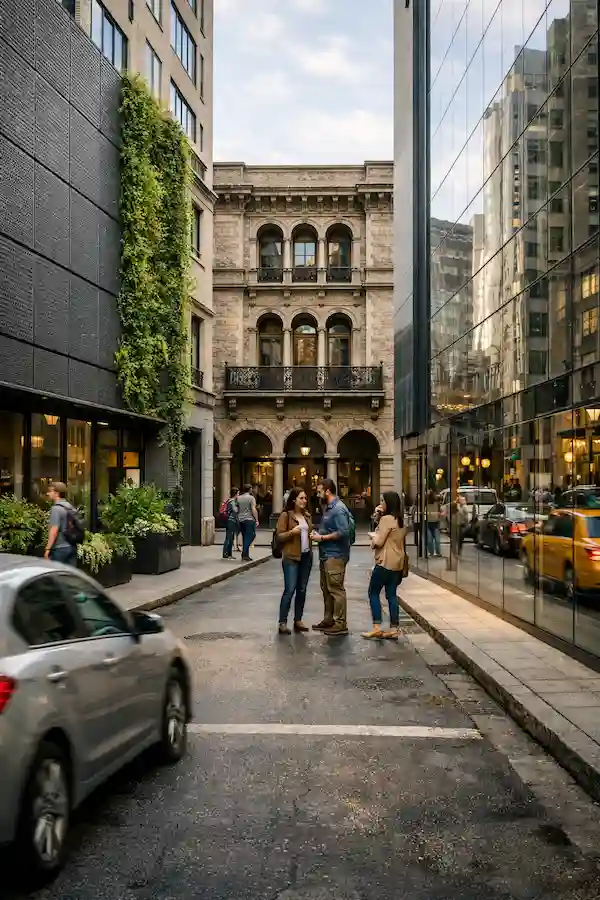
Human sounds—such as laughter, conversation, and music—play a vital role in enhancing social interaction within compact urban spaces. These sounds are not merely background noise; they are signals of community life, fostering a sense of belonging and shared experience. Within the framework of Engineering the Soundscape, the presence of human sounds is intentionally designed to stimulate social willingness and encourage interaction among diverse groups.
The balance between stimulation and suitability is central to this process. Stimulation refers to engaging sounds that energize social activity, such as live music or the buzz of conversation in a plaza. Suitability, on the other hand, ensures that these sounds remain appropriate to the context, avoiding overwhelming or intrusive effects. Jingwen Cao’s research demonstrates that closer social groups tend to evaluate interactive sounds more positively, while distant groups require a more carefully balanced soundscape to feel comfortable. By applying Engineering the Soundscape, designers can calibrate this balance, ensuring that spaces remain lively without sacrificing tranquility.
Findings from case studies highlight that event sounds—such as festivals or public performances—can significantly boost social interaction, drawing people together and increasing community engagement. However, these same sounds may reduce perceived suitability if they dominate the environment for too long or at excessive volumes. The challenge, therefore, lies in orchestrating soundscapes that provide stimulation while maintaining harmony with everyday activities.
Ultimately, Engineering the Soundscape in compact urban spaces requires recognizing human sounds as essential resources. By designing environments that balance stimulation and suitability, architects and planners can foster social comfort, strengthen community identity, and create spaces that are both vibrant and restorative.
Stimulation vs. Suitability
| Dimension | Stimulation (Engaging Sounds) | Suitability (Appropriate Sounds) |
|---|---|---|
| Definition | Sounds that energize and encourage social activity. | Sounds that fit the context and do not overwhelm users. |
| Examples | Laughter, conversation, live music, event sounds. | Background chatter, soft water features, birdsong. |
| Impact on Social Comfort | Boosts interaction, draws people together, enhances community identity. | Maintains harmony, prevents fatigue, supports relaxation. |
| Risks | Can dominate the environment, reducing perceived suitability. | May feel too quiet or sterile if overstressed. |
| Design Strategy in Engineering the Soundscape | Introduce stimulating sounds to foster vibrancy and sociability. | Balance stimulation with appropriateness to sustain comfort. |
| Case Study Insight | Jingwen Cao’s findings: event sounds increase social willingness but reduce suitability if excessive. | WHO guidelines emphasize moderation to protect psychological well-being. |
6. Case Studies in the United States
Gainesville, Florida – Urban Village Soundscape
- Context: Southwest 20th Avenue corridor, linking suburbs with the University of Florida.
- Methods: Long-term acoustic measurements, soundwalks, and stakeholder focus groups.
- Findings: Noise from interstate traffic was dominant; design strategies included buffering with vegetation, integrating multi-modal transport, and adding soundscape elements like water features.
- Impact: Demonstrated how Engineering the Soundscape can be embedded in sustainable urban village planning. soundscape-intervention.org
New York City – Pocket Parks and Plazas
- Context: Privately Owned Public Spaces (POPS) such as Paley Park and Greenacre Park.
- Methods: Observational soundwalks and acoustic mapping.
- Findings: Water features and dense greenery masked traffic noise, creating tranquil micro-environments.
- Impact: Shows how Engineering the Soundscape can transform small urban sites into restorative escapes, balancing stimulation (human voices, music) with suitability (natural masking sounds). AIP Publishing
Mixed-Use Communities – U.S. Cities (Siebein Associates Studies)
- Context: Case studies across three large U.S. cities with vibrant entertainment districts.
- Methods: Dynamic documentation, community soundwalks, and acoustic modeling.
- Findings: Entertainment sounds were both valued and contested; solutions included façade articulation, zoning adjustments, and acoustic codes.
- Impact: Reinforced that Engineering the Soundscape requires balancing economic vibrancy with residents’ need for tranquility. dael.euracoustics.org
Comparative Table
| City/Case | Focus | Key Strategy | Impact |
|---|---|---|---|
| Gainesville, FL | Corridor & urban village | Vegetation buffers, multi-modal design | Reduced interstate noise, improved livability |
| New York City | Pocket parks (POPS) | Water features, greenery | Masked traffic noise, created tranquil escapes |
| Mixed-use U.S. Cities | Entertainment districts | Façade articulation, zoning, codes | Balanced nightlife sounds with residential comfort |
Key Takeaway
By shifting case studies to the U.S., we see how Engineering the Soundscape is applied in diverse contexts—from Florida’s suburban-urban corridors to Manhattan’s pocket parks and entertainment districts nationwide. Each example demonstrates that façades, vegetation, and acoustic monitoring are essential tools for creating sensory comfort in compact urban spaces.
Conclusion
Integrating acoustics into compact urban design is not simply a technical necessity but a fundamental aspect of enhancing sensory comfort and quality of life. Within the framework of Engineering the Soundscape, sound is treated as a resource rather than waste, allowing designers to create environments that are restorative, socially vibrant, and culturally meaningful.
Urban policies must begin to prioritize sensory comfort, recognizing that noise pollution is not only a public health issue but also a barrier to social interaction and community identity. By embedding soundscape considerations into planning codes, façade engineering, and green infrastructure, cities can foster spaces that balance tranquility with stimulation.
Looking ahead, future directions point toward the use of artificial intelligence to analyze sound usage patterns. AI-driven tools can identify dominant sources, predict social responses, and optimize design strategies in real time. This technological integration will allow Engineering the Soundscape to evolve from static design into dynamic, adaptive management of urban sound environments.
Ultimately, compact urban spaces can become models of sensory comfort when acoustics are integrated alongside visual and social dimensions. The challenge for architects, planners, and policymakers is to embrace soundscape design as a central pillar of sustainable and human-centered urbanism.
📚 References
- Crippa, T., Dagnini, E., Davies, G., & Rees, H. (2019). Façade Engineering and Soundscape. BuroHappold Engineering, London.
- Cao, J. (2022). Soundscape and Social Relationships in Urban Public Spaces. Doctoral Thesis, University of Sheffield.
- Martucci, C. (2021). Designing Cities Through Sound: A Comparative Study of Urban Spaces and Soundscapes. Undergraduate Honors Thesis, University of Florida.
- De Coensel, B., Boes, M., Oldoni, D., & Botteldooren, D. (2013). Characterizing the Soundscape of Tranquil Urban Spaces. Proceedings of Meetings on Acoustics, 19, 040052.
- Kang, J., & Schulte-Fortkamp, B. (2016). Soundscape and the Built Environment. CRC Press, Boca Raton.
- Kang, J. (2023). Soundscape in City and Built Environment: Current Developments and Design Potentials. City and Built Environment, 1(1), 1–16.