
Introduction: Light and Quality of Life in Compact Spaces
In contemporary living, light is no longer a passive element—it is a dynamic force that shapes how we perceive space, time, and well-being. The relationship between light and quality of life extends beyond aesthetics; it touches the very rhythm of human physiology and psychology. As modern lifestyles increasingly confine people to compact interiors, the engineering of light becomes essential to maintaining balance between functionality and emotional comfort.
Artificial lighting, when designed through the lens of Human-Centric Lighting (HCL), can replicate the natural variations of daylight that regulate our circadian rhythm. This synchronization between light and biology enhances sleep quality, stabilizes mood, and supports mental clarity. In small living environments, where exposure to natural light is limited, engineered illumination can restore the sense of openness and vitality that daylight provides.
The importance of this topic lies in its intersection of technology, architecture, and human health. Compact spaces—urban apartments, micro-offices, and modular homes—demand lighting systems that do more than illuminate; they must support psychological well-being and productivity. Through spectral tuning, dynamic control, and architectural integration, light becomes a medium of restoration and focus, transforming confined interiors into environments that nurture both body and mind.
The research goal of this study is to explore how light engineering can enhance mental comfort and productivity in compact spaces. By examining the principles of Human-Centric Lighting and its practical applications, the article aims to demonstrate that light is not merely a design component—it is a living system that sustains human health, creativity, and emotional equilibrium.
Scientific Foundations: Human-Centric Lighting and Circadian Rhythms Human-Centric Lighting (HCL) is a design approach that aligns artificial light with human biological rhythms, supporting comfort, productivity, and well-being. It adapts brightness and color temperature throughout the day to mimic natural daylight and regulate circadian rhythms. According to LEDVANCE, HCL systems are increasingly applied in offices, schools, hospitals, and homes to enhance sleep quality, focus, and emotional balance.
1. Scientific Foundations: Human-Centric Lighting and Circadian Rhythms

Artificial lighting is more than a functional or aesthetic element of modern architecture; it is a biological signal that profoundly influences human health. The emerging field of Human-Centric Lighting (HCL) recognizes that light is not static but dynamic, and that its spectral qualities and intensity must align with the body’s circadian rhythm to sustain well-being.
Research shows that our circadian rhythm—the internal clock regulating sleep, alertness, and hormonal cycles—is highly sensitive to light exposure. Light entering the retina is processed by specialized cells that transmit signals to the brain, influencing endocrine activity and the secretion of melatonin. As one whitepaper notes, “By aligning artificial lighting with the natural patterns of the human body, lighting integration supports the body’s innate biological processes, promoting better sleep quality, mood regulation, and overall physiological health.”
Poor lighting, such as static intensity or inappropriate color temperature, can disrupt this rhythm. Intense white light at night suppresses melatonin, leading to insomnia, mood disturbances, and even increased risk of depression. Conversely, controlled exposure to dynamic light has therapeutic effects, reducing symptoms of seasonal affective disorder and improving workplace satisfaction. Surveys cited in the literature reveal that over 80% of office workers report frustration with inadequate lighting, while nearly one-third believe improved lighting would enhance their happiness.
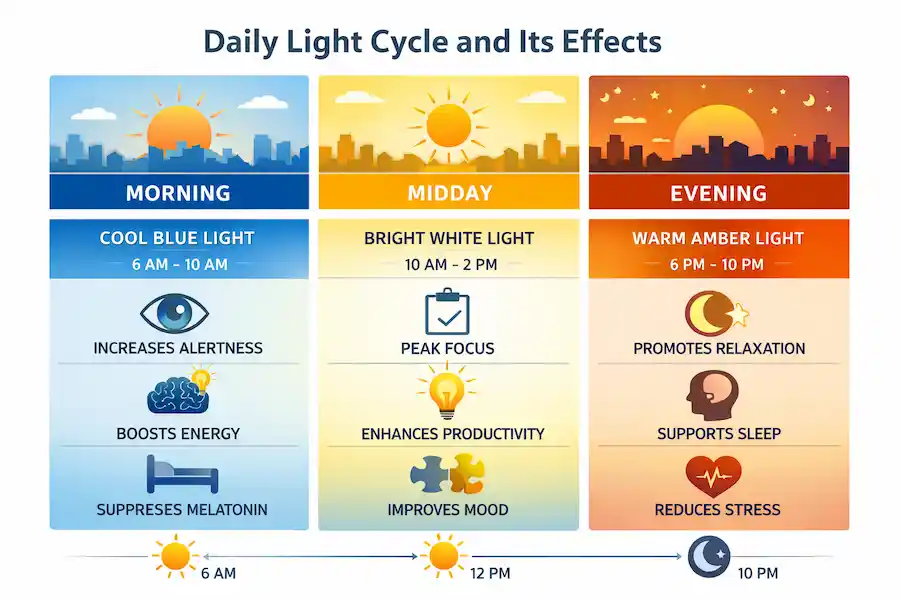
The foundation of Human-Centric Lighting lies in mimicking the natural fluctuations of daylight. Warm white light in the evening promotes relaxation, while cool white light rich in blue wavelengths stimulates alertness in the morning. Advanced tunable LED systems, combined with intelligent controls, now allow designers to replicate these natural cycles indoors. Studies highlight that such systems can improve concentration in schools, reduce fatigue among hospital staff, and accelerate patient recovery.
From a spectral perspective, innovations in LED engineering have made it possible to approximate daylight’s evolving spectral power distribution. Scientific reports emphasize that color-tunable LEDs and hybrid light sources can achieve high fidelity in both visual and circadian performance, ensuring that artificial light supports neurobiological functions as effectively as natural sunlight.
In compact spaces, where access to natural daylight is limited, Human-Centric Lighting becomes not just a design choice but a health imperative. By embedding tunable lighting into architectural systems—such as metal ceilings or modular fixtures—designers can create environments that actively reinforce circadian health, enhance productivity, and elevate overall quality of life.
2. Scientific Foundations: Human-Centric Lighting, Circadian Rhythm, and Spectral Effects
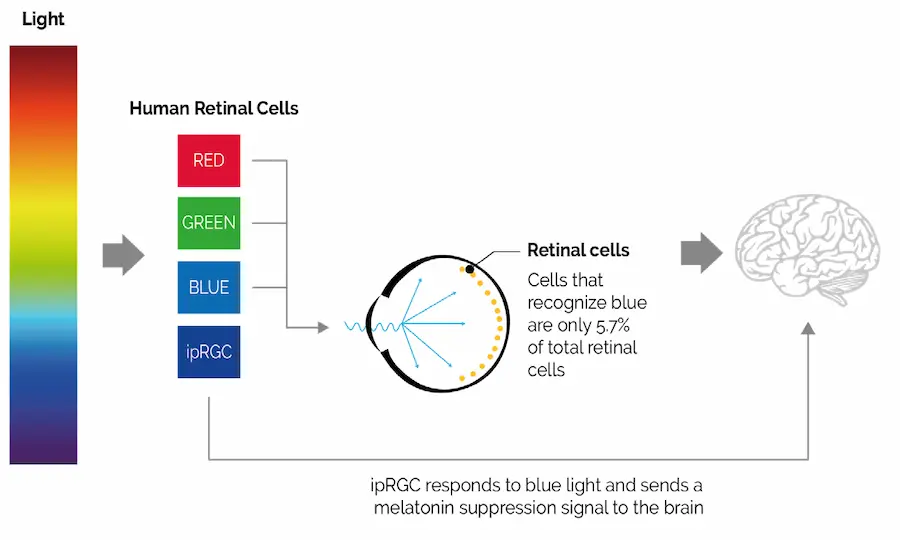
The science behind Human-Centric Lighting (HCL) rests on the recognition that light is not merely a visual aid but a biological regulator. Our circadian rhythm—the internal clock that governs sleep, alertness, and hormonal cycles—is highly sensitive to light exposure. As the Network Architectural Whitepaper explains, “By aligning artificial lighting with the natural patterns of the human body, lighting integration supports the body’s innate biological processes, promoting better sleep quality, mood regulation, and overall physiological health.”
Circadian Rhythm and Light
Light entering the retina is detected by specialized cells, including intrinsically photosensitive retinal ganglion cells (ipRGCs), which transmit signals to the brain’s suprachiasmatic nucleus. These signals regulate melatonin secretion, blood pressure, and body temperature. Exposure to bright, cool light in the morning suppresses melatonin and elevates cortisol, preparing the body for alertness and activity. Conversely, warm, dim light in the evening promotes melatonin release, supporting relaxation and sleep. Studies cited in the Helvar Whitepaper emphasize that “powerful bluish morning light suppresses melatonin… allowing you to be alert, active and ready for the working day.”
Poor lighting disrupts this rhythm. Static intensity or inappropriate color temperature—such as intense white light at night—can cause insomnia, mood disturbances, and even depression. Surveys show that 83% of office workers report frustration with workplace lighting, while 32% believe improved lighting would increase happiness.
Spectral Qualities, Mood, and Productivity
The spectral composition of light plays a critical role in emotional well-being and cognitive performance. Research in Scientific Reports demonstrates that tunable LED systems can approximate daylight’s evolving spectral power distribution, achieving high fidelity in both visual and circadian performance. These systems deliver cool white light rich in blue wavelengths during the day to stimulate alertness and focus, and warm white light in the evening to promote relaxation.
Industry perspectives reinforce this point. The Frontiers in Neuroscience paper highlights that biologically relevant lighting must provide “brighter days and darker nights” to prevent circadian dysfunction, which is linked to reduced attention, increased risk of obesity, and cardiovascular disease.
In practice, Human-Centric Lighting has been shown to:
- Enhance concentration and reduce fatigue in schools.
- Improve patient recovery and reduce staff exhaustion in hospitals.
- Increase motivation, accuracy, and satisfaction in workplaces.
By engineering spectral qualities to mimic natural daylight cycles, HCL transforms compact spaces into environments that actively support mental clarity, emotional balance, and productivity.
3. Engineering Solutions: Human-Centric Lighting Technologies
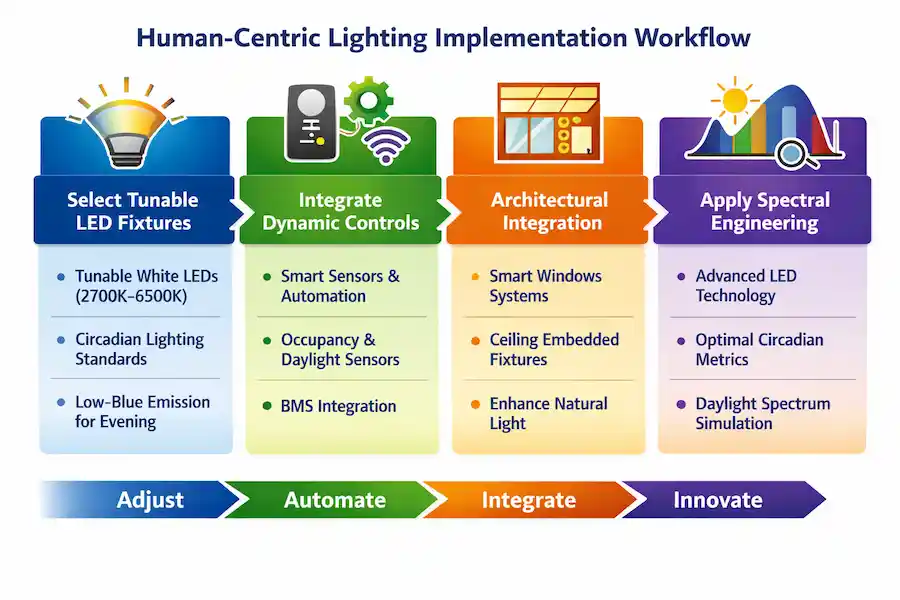
The practical implementation of Human-Centric Lighting (HCL) relies on engineering solutions that replicate the dynamic qualities of natural daylight. Modern systems combine tunable LEDs, intelligent controls, and architectural innovations to create environments that actively support circadian health, mood regulation, and productivity.
LED Technologies
Tunable white LED systems are at the core of HCL. Unlike static fluorescent or incandescent lamps, tunable LEDs can adjust color temperature from warm (≈2700K) to cool (≈6500K), simulating the natural progression of daylight. As noted in the ESSE-CI Whitepaper, these systems “allow the management of tunable color temperatures along the Planck curve… transforming artificial light into an automatic adjustment system based on the human circadian rhythm.” Such flexibility ensures that occupants receive stimulating blue-rich light in the morning and calming warm light in the evening.
Dynamic Control Systems
Intelligent lighting controls integrate sensors, dimmable drivers, and building management systems to automate circadian lighting. The Helvar Whitepaper highlights that automated systems can “change the mood of a room according to purpose, time of day, natural daylight, and occupancy.” These controls not only improve well-being but also enhance energy efficiency by adjusting illumination based on real-time environmental conditions.
Smart Windows and Architectural Integration
In compact spaces, access to natural daylight is limited. Smart windows and reflective surfaces can amplify daylight penetration, while integrated ceiling systems embed HCL-compatible fixtures seamlessly into architectural structures. The Network Architectural Whitepaper emphasizes that “working closely with architects and engineers early in the design process ensures fixtures can be integrated into metal ceiling structures without compromising design.”
Spectral Engineering Advances
In short, human‑centric smart lighting is not a luxury—it is an investment in everyday health and comfort. By adopting solutions like Human‑Centric Lighting with Govee RGBIC Floor Lamp, consumers can enjoy balanced energy during the day, deeper relaxation at night, and a healthier lifestyle overall. Recent research in Scientific Reports demonstrates that hybrid LED sources using advanced spectral engineering can approximate daylight’s spectral power distribution with high fidelity. These innovations ensure both visual comfort and circadian effectiveness, bridging the gap between artificial and natural light. For a deeper exploration of how these principles apply in compact living environments, see our article Human‑Centric Lighting with Govee RGBIC Floor Lamp: Transforming Small Rooms into Smart Comfort Zones.
📊 Comparative Table of Human-Centric Lighting Solutions
| Technical Solution | Advantages | Limitations | Practical Applications |
|---|---|---|---|
| Tunable LED Systems | – Adjustable color temperature (2700K–6500K) to simulate daylight. – High energy efficiency. – Provides stimulating cool light in the morning and relaxing warm light in the evening. | – Higher initial cost. – Requires periodic maintenance. | Offices, schools, hospitals (ESSE-CI Whitepaper). |
| Dynamic Control Systems | – Smart sensors for real-time adjustment based on time and occupancy. – Integration with Building Management Systems (BMS). – Enhances productivity and reduces energy consumption. | – Complex installation and programming. – Requires user training for optimal use. | DALI systems, Helvar iC (Helvar Whitepaper). |
| Smart Windows & Architectural Integration | – Maximizes natural daylight penetration. – Reduces reliance on artificial lighting. – Seamless integration into ceiling and architectural structures. | – Limited effectiveness in small spaces with poor sunlight exposure. – High retrofitting costs in existing buildings. | Metal ceiling integration with HCL (Network Architectural Whitepaper). |
This table shows that Tunable LEDs provide spectral flexibility, Dynamic Controls add intelligence and adaptability, while Smart Windows and architectural integration enhance natural light and embed HCL into the built environment.
4. Impact on Quality of Life: Human-Centric Lighting in Compact Spaces
The integration of Human-Centric Lighting (HCL) into compact living environments is not only a matter of design aesthetics but a profound contributor to human health and well-being. By aligning artificial light with the body’s circadian rhythm and tailoring spectral qualities to human needs, HCL directly improves sleep, mental health, productivity, and stress reduction.
This scientific approach to light is not an isolated luxury—it is a fundamental component of a broader lifestyle philosophy. In fact, lighting serves as one of the 7 Pillars of a More Comfortable Life, a framework I explored in depth in my recent architectural analysis: ‘The Philosophy of Quality of Life in Small Spaces: The 7 Pillars of a More Comfortable Life‘ .Understanding how light affects our DNA is the first step toward reclaiming our well-being in the modern urban jungle.
Improving Sleep and Mental Health
Light is the primary synchronizer of the circadian rhythm. Exposure to cool, blue-enriched light in the morning suppresses melatonin and elevates cortisol, preparing the body for alertness. Conversely, warm, dim light in the evening promotes melatonin release, supporting relaxation and restorative sleep. As the Network Architectural Whitepaper notes, “By aligning artificial lighting with the natural patterns of the human body, lighting integration supports the body’s innate biological processes, promoting better sleep quality, mood regulation, and overall physiological health.” Controlled exposure to dynamic light has also been shown to reduce symptoms of depression, including seasonal affective disorder, highlighting its therapeutic potential.
Enhancing Productivity and Creativity
Spectral engineering of LED systems allows artificial light to mimic daylight’s evolving qualities, which directly impacts cognitive performance. The Helvar Whitepaper emphasizes that “powerful bluish morning light suppresses melatonin… allowing you to be alert, active and ready for the working day.” In workplaces and schools, HCL systems improve concentration, reduce fatigue, and increase accuracy. In hospitals, they enhance patient recovery and reduce staff exhaustion. By providing biologically relevant lighting cycles, compact spaces can become environments that foster creativity and sustained productivity.
Reducing Stress in Small Environments
Poor lighting—characterized by static intensity, glare, or inappropriate color temperature—has been linked to headaches, eye strain, and workplace dissatisfaction. Surveys cited in the Staples UK study reveal that 80% of office workers emphasize the importance of adequate lighting, with 32% reporting that improved lighting would increase happiness. In compact spaces, where environmental stressors are amplified, HCL mitigates these effects by creating balanced illumination that reduces tension and supports emotional stability.
5. Case Studies: Applications of Human-Centric Lighting
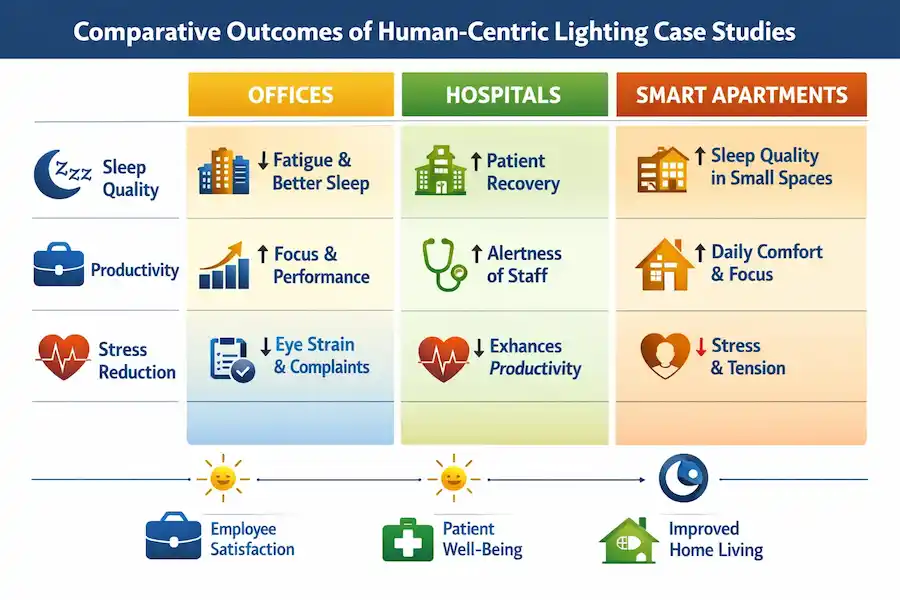
The real-world adoption of Human-Centric Lighting (HCL) demonstrates how dynamic light systems can transform environments into healthier, more productive, and emotionally balanced spaces. Across offices, hospitals, and smart apartments, HCL technologies have proven their ability to synchronize artificial light with human biological rhythms, improving both performance and well-being.
Office Environments
In corporate settings, HCL systems have been integrated to enhance focus and reduce fatigue. The Helvar Whitepaper describes how automated lighting controls adjust color temperature and intensity throughout the day, creating “energizing cool light during working hours and relaxing warm light in the evening.” Offices equipped with tunable LED systems report higher employee satisfaction and fewer complaints of glare or eye strain. A UK survey cited in the Network Architectural Whitepaper found that 83% of workers were dissatisfied with static lighting, while dynamic circadian lighting improved comfort and productivity.
Healthcare Facilities
Hospitals and aged-care centers have adopted HCL to support patient recovery and staff endurance. The ESSE-CI Human Centric Lighting report highlights that dynamic lighting cycles “enhance concentration and prevent tiredness by introducing cold color temperatures at the right time, and promote relaxation through warmer tones.” In patient rooms, tunable white LEDs simulate daylight transitions, helping regulate sleep patterns and reduce anxiety. For night-shift staff, cooler light during active hours and warmer light during rest periods maintain alertness without disrupting circadian balance.
Smart Apartments and Compact Living Spaces
In compact residential environments, where access to natural daylight is limited, HCL provides a vital substitute for sunlight. The Network Architectural Whitepaper emphasizes integrating tunable LED fixtures into metal ceiling systems, allowing seamless control of light intensity and color temperature. Smart apartments equipped with sensor-based lighting automatically adjust illumination based on time of day and occupancy, creating biologically supportive atmospheres. These systems not only improve sleep quality but also reduce stress and enhance the sense of spaciousness in small interiors.
Conclusion: Light as a Philosophical and Engineering Tool
The journey through Human-Centric Lighting (HCL) reveals that light is far more than a technical necessity—it is a philosophical and engineering medium that shapes how we live, think, and feel. By aligning artificial illumination with the natural rhythm of the human body, designers and engineers are not merely solving functional problems; they are redefining the relationship between humans and their built environments.
Light becomes a philosophical tool when it restores harmony between technology and biology—bridging the gap between the mechanical and the organic. It becomes an engineering tool when it transforms compact spaces into living systems that respond intelligently to human needs. Through spectral tuning, dynamic control, and architectural integration, HCL embodies a holistic approach to design—one that merges science, aesthetics, and well-being.
In compact spaces, where every square meter matters, Human-Centric Lighting offers a pathway to quality of life. It enhances sleep, mental clarity, and emotional balance while fostering creativity and productivity. The engineering of light thus becomes an act of care—a way to design environments that nurture human flourishing.
Ultimately, the philosophy behind HCL reminds us that light is not just energy; it is experience. It is the invisible architecture of comfort, cognition, and connection—a daily rhythm engineered to sustain life itself. This reflection aligns with the broader perspective explored in Adaptive Flexibility and Quality of Life: Designing Compact Spaces That Evolve with Your Desire, where light, sound, and air converge to form a holistic framework of sensory comfort and adaptive design in compact environments.
📚 References
- Blume, C., Garbazza, C., & Spitschan, M. (2019). Effects of light on human circadian rhythms, sleep and mood. Somnologie, 23(3), 147–156.
- Suni, E., & Singh, A. (2024). Light and Sleep. Sleep Foundation.
- Osibona, O., Solomon, B. D., & Fecht, D. (2021). Lighting in the Home and Health: A Systematic Review. International Journal of Environmental Research and Public Health, 18(2), 609.
- Juslén, H. T., & Tenner, A. D. (2005). Mechanisms involved in enhancing human performance by changing the lighting in the industrial workplace. International Journal of Industrial Ergonomics, 35, 843–855.
- Juslén, H. T., & Tenner, A. D. (2007). The use of task lighting in an industrial work area provided with daylight. Journal of Light & Visual Environment, 31(1), 25–31.
- Moreno, O., Fuentes-Hernandez, C., & Kippelen, B. (2024). Redefining artificial lighting through spectral engineering of light sources for well-being. Scientific Reports, 14:26298.
- Soler, R., & Voss, E. (2021). Biologically Relevant Lighting: An Industry Perspective. Frontiers in Neuroscience, 15:637221.
- ESSE-CI. (2024). Human Centric Lighting – Living Light. ESSE-CI Technical Whitepaper.
- Network Architectural. (2024). Human-Centric Lighting: Lighting Integration Options for Metal Ceilings. Network Architectural Whitepaper.
- Helvar. (2024). Human Centric Lighting – Second Sun. Helvar Technical Whitepaper.