
Introduction
In the contemporary urban landscape, the compact habitat has evolved from a byproduct of scarcity into a deliberate frontier of architectural innovation. As metropolitan centers face unprecedented density, the challenge for modern design is to ensure that limited physical dimensions do not translate into a diminished quality of life. True success in this domain is measured by smart built capital—the strategic integration of physical infrastructure and technological intelligence to minimize environmental friction. This article explores how spatial flow and harmony can be architected in small spaces by synthesizing structural order, temporal rhythms, and economic flow theories.
1. Structural Order and Visual Continuity
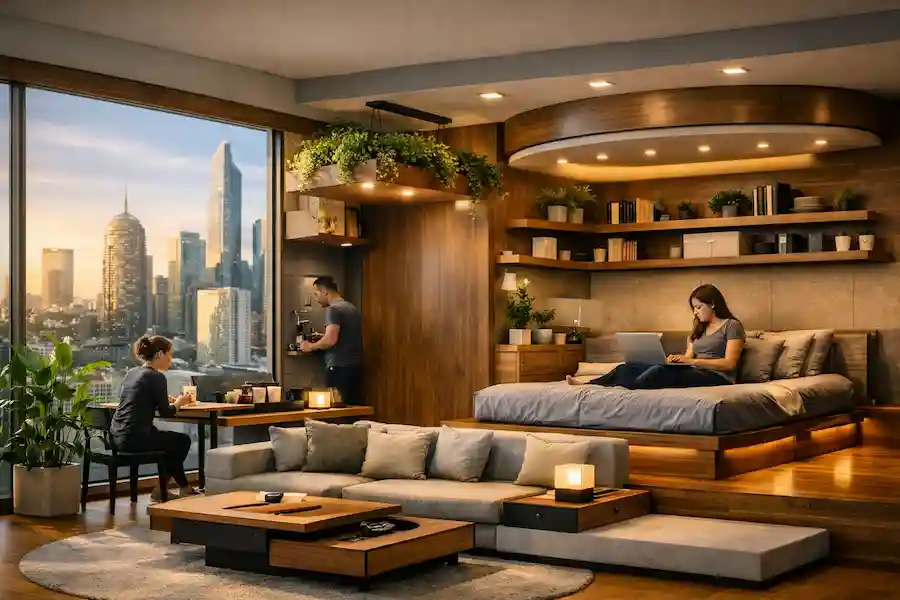
The foundation of any compact habitat lies in its structural logic. Francis D.K. Ching, in his seminal work Architecture: Form, Space, & Order, argues that space is defined by the relationship between form and the void. In small-scale living, every inch of smart built capital must be multi-functional. Spatial flow is not merely a path for walking; it is a visual and psychological journey. Ching’s principles of hierarchy and datum suggest that by establishing a clear visual anchor—perhaps a central modular unit—the rest of the space can rotate around it, creating a sense of spatial flow that defies physical boundaries.
Recent academic validation of microscale atmospheric modeling further confirms how spatial flow interacts with environmental friction in urban habitats (Dey et al., 2023, ASME Journal of Engineering for Sustainable Buildings and Cities).
Visual continuity is essential to reducing the perceived environmental friction of a small room. When materials, colors, and lighting are unified, the eye perceives a single, expansive “field” rather than a series of cramped boxes. This continuity enhances the occupant’s quality of life by providing a serene, uncluttered environment where the transition between working, sleeping, and socializing is fluid and intuitive.
2. Rhythmanalysis: The Temporal Harmony of Space
Beyond the physical, a compact habitat must harmonize with the temporal needs of its inhabitants. Henri Lefebvre’s Rhythmanalysis offers a profound lens: space is a collection of rhythms. To achieve spatial flow, a designer must map the “eurhythmia”—the healthy interaction of biological and social rhythms—within the home. Smart built capital enables this by allowing a single space to change its rhythm; for instance, smart lighting systems that shift from high-energy blue tones for morning work to warm, dim amber for evening rest.
When rhythms conflict, such as when a cluttered kitchen interferes with a nearby relaxation zone, environmental friction increases. By applying Lefebvre’s concepts, designers can create “intermodal” zones that adapt to the user’s schedule. This temporal flexibility is a primary driver of quality of life in modern urban living, ensuring that the compact habitat remains a place of rejuvenation rather than a source of stress.
3. Spatial Economics and the Efficiency of Movement
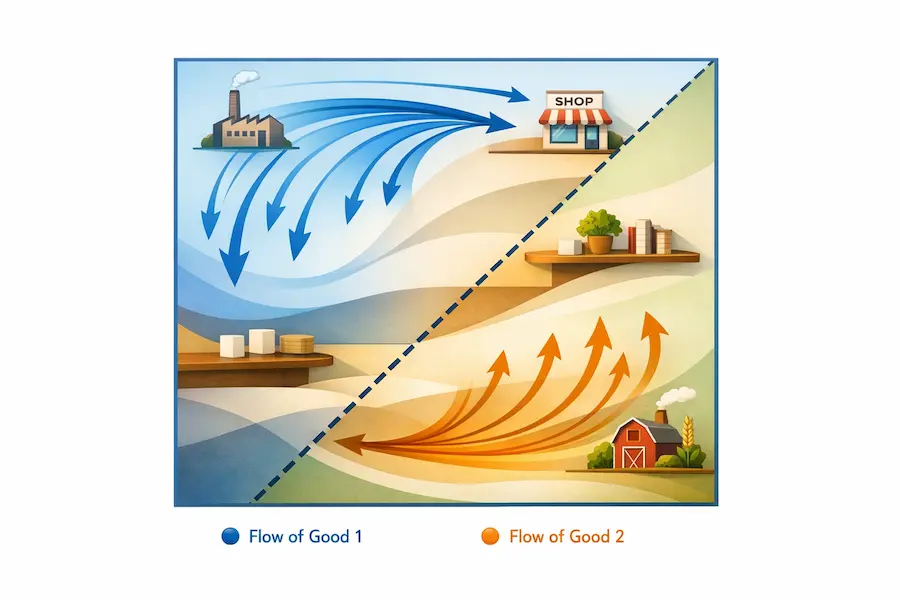
The optimization of spatial flow can also be understood through the rigorous lens of Spatial Economics. Beckmann and Puu describe the “Least-Cost Principle,” where movement within a field is dictated by the desire to minimize effort. In a compact habitat, this “cost” is both physical and cognitive. Every unnecessary step or obstructed path adds to environmental friction. By treating the floor plan as a continuous vector field, we can use the “Gradient Law” to align the most frequent daily paths with the most open areas of the home.
For example, if the transition between a storage area and a workspace is cumbersome, the “economic cost” of the activity rises, subtly degrading the occupant’s quality of life over time. Smart built capital addresses this by employing robotic furniture or sliding partitions that align with these “flow lines.” When the physical layout matches the mathematical optimum of movement, spatial flow becomes effortless, and the home feels inherently harmonious.
4. Reducing Environmental Friction through Smart Integration
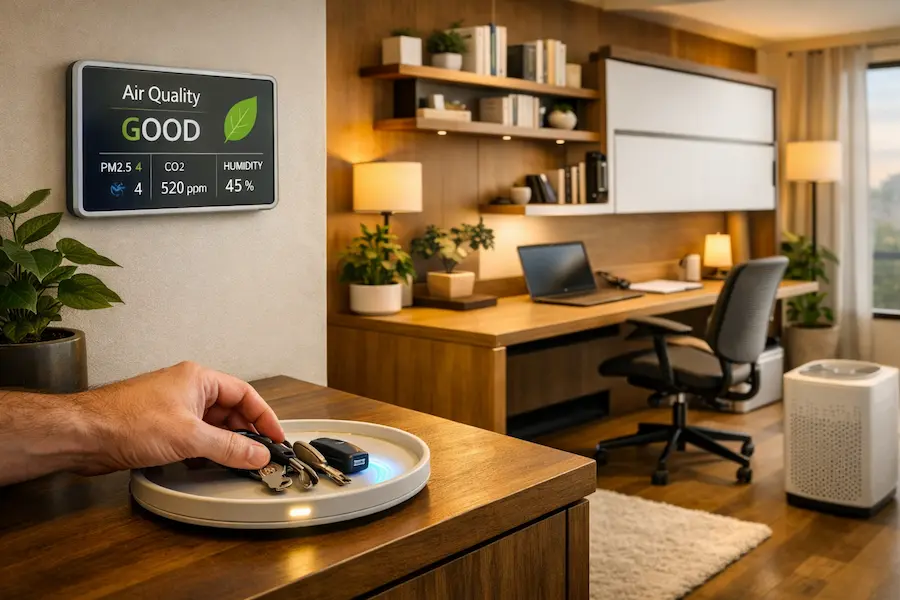
The ultimate goal of smart built capital is the total elimination of environmental friction. This is the “static” of daily life—the lost keys, the cramped corners, and the poor air quality. In a compact habitat, these issues are magnified. However, by integrating ambient sensors and AI-driven management, the home can proactively adjust to the occupant. Whether it is optimizing air circulation or automating the transformation of a “spatial utility” unit, technology serves to maintain spatial flow and protect the quality of life.
Conclusion
The future of urban dwelling lies in our ability to design for spatial flow and harmony within the compact habitat. By synthesizing the architectural order of Ching, the rhythmic insights of Lefebvre, and the economic efficiencies of Beckmann and Puu, we can build smart built capital that transcends size. When we minimize environmental friction, we don’t just save space; we expand the potential for a fulfilling quality of life.
References:
• Beckmann, M. J., & Puu, T. (1985). Spatial Economics: Density, Potential, and Flow. North-Holland.
• Ching, F. D. K. (2007). Architecture: Form, Space, & Order (3rd ed.). John Wiley & Sons.
• Lefebvre, H. (2004). Rhythmanalysis: Space, Time and Everyday Life. Continuum.
• Stanford Emerging Technology Review. (2026). A Report on Ten Key Technologies (Supervised by Herbert S. Lin).