The Architecture of Well-being: A Multidimensional Analysis of Quality of Life and the Challenge of Restricted Living
Introduction
The quest for a “good life” is a timeless human endeavor that has transitioned from ancient biblical wisdom and Greek philosophy into a rigorous, multidimensional scientific field. Quality of Life (QOL) is no longer viewed through a narrow lens of physical health or economic status; rather, it is recognized as a complex interplay of objective conditions and subjective perceptions. As urbanization accelerates, a new frontier in QOL research has emerged: the impact of living in small, restricted spaces on the human psyche and social fabric.
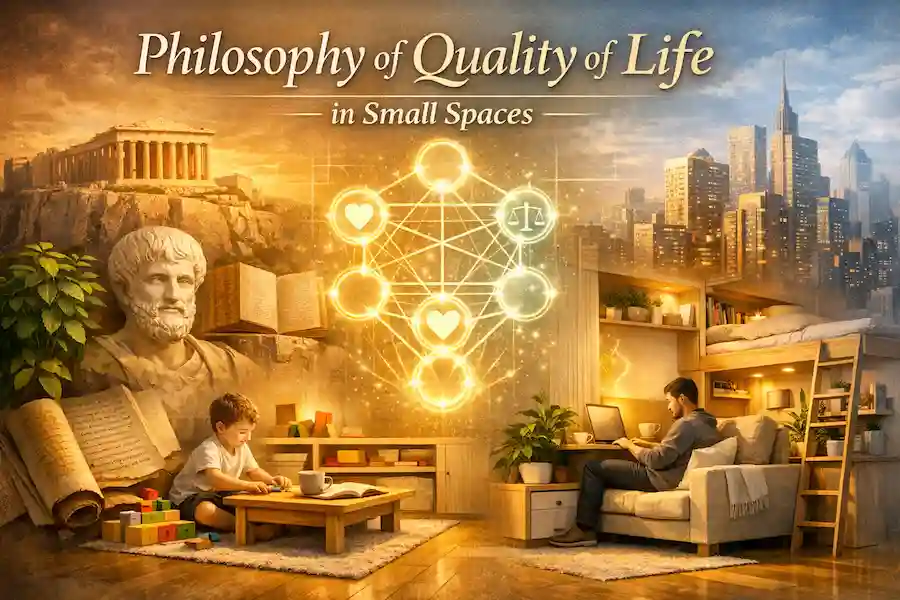
The Philosophy of Quality of Life: Bridging the gap between classical thought and the modern challenges of restricted living through a multidimensional lens.1. The Five Dimensions of Quality of Life
According to established models, Quality of Life is categorized into five distinct yet overlapping dimensions that constitute the “Tree of Life” for human flourishing:
- Physical Well-being: This includes health, fitness, mobility, and personal safety.
- Material Well-being: Encompasses financial security, housing quality, and ownership of possessions.
- Social Well-being: Relates to interpersonal relationships, social integration, and the quality of community support.
- Emotional Well-being: Focuses on mental health, self-esteem, faith, and the absence of distress.
- Development and Activity: Involves the ability to pursue education, engage in productive work, and enjoy leisure activities.
A combined approach to measuring these dimensions is essential to maximize the utility of QOL interventions.
2. The Biopsychosocial Paradigm: A Holistic Shift
The medical and social sciences have largely moved toward a Biopsychosocial Paradigm. This model acknowledges that biological factors alone do not determine well-being. For instance, an individual might be physically healthy but suffer from a low Quality of Life due to social isolation or a lack of intellectual stimulation. Conversely, individuals with chronic illnesses can report a high Quality of Life if they possess strong emotional resilience and social support.
3. Philosophical Underpinnings: Thomas Scanlon and Substantive Goods
The philosophical work of Thomas Scanlon provides a crucial framework for understanding Quality of Life. Scanlon’s Substantive Good Theory argues that well-being is tied to components that hold intrinsic value, such as rational activity, friendship, and the development of one’s abilities.
Scanlon’s perspective challenges the purely “desire-fulfillment” model. If an individual living in a tiny, cramped space “desires” nothing more, it does not necessarily mean their life is of high quality. Instead, Scanlon suggests we must look at whether the environment allows for the exercise of “rational agency.” If a living space is so restricted that it prevents a person from pursuing hobbies, hosting friends, or finding quiet for reflection, it fundamentally undermines their “substantive goods.”
4. The Contemporary Challenge: Living in “Small Spaces”
In many modern urban centers, “Small Space Living” has become a necessity rather than a choice. While minimalist movements celebrate efficiency, the reality of restricted environments poses significant challenges to the five dimensions of Quality of Life:
A. The Sensory and Psychological Burden
Restricted living environments often lead to a phenomenon known as “clutter-induced stress.” When the physical environment is cramped, the mind often feels the same. According to the emotional well-being dimension, a home should be a sanctuary. However, in micro-apartments, the lack of “aesthetic distance”—a concept often discussed in reception theory—can lead to psychological fatigue.
B. The Social Pillar and “The Third Space”
Social well-being relies on the ability to interact with others. Small apartments often lack the capacity for “social hosting,” which can lead to isolation. Residents are forced to find “Third Spaces” (cafes, parks, or libraries) to fulfill their social needs. If these external spaces are unavailable, the social dimension of QOL collapses.
C. Development and Activity Constraints
For researchers, graduate students, or professionals, the “Development and Activity” dimension requires a dedicated space for “rational activity” (in Scanlon’s terms). When a living room must double as a bedroom, office, and kitchen, the boundary between rest and work blurs, leading to decreased productivity and increased burnout.
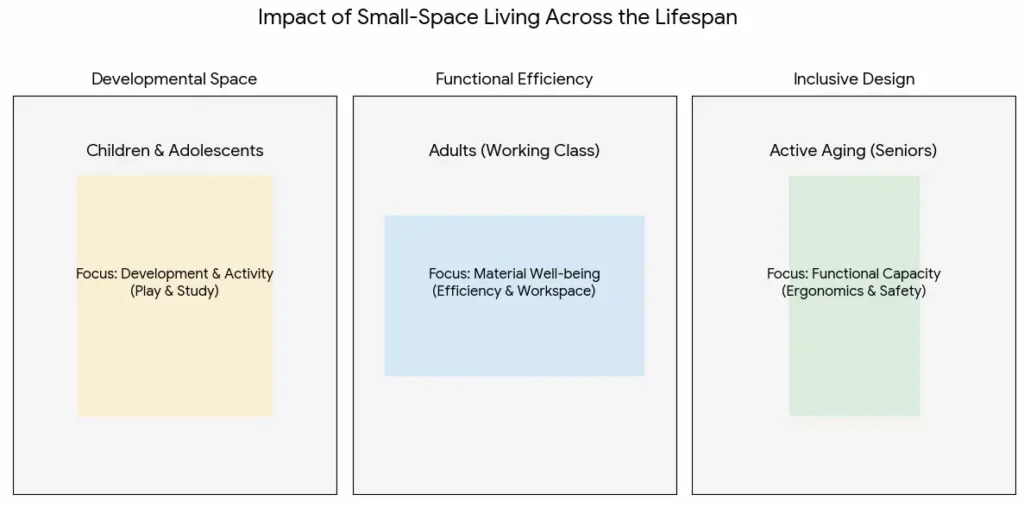
5. Life-Stage Specificity in Quality of Life
The impact of the environment varies significantly across the lifespan:
- Children and Adolescents: QOL in youth is heavily dependent on the “Development and Activity” dimension. Children in small spaces may face developmental hurdles if they lack areas for physical play or quiet study.
- Adults: For the working population, “Material Well-being” and “Development” are paramount. The ability to manage a household efficiently within a small footprint is a key determinant of their perceived QOL.
- Active Aging: For seniors, QOL is tied to “Functional Capacity.” A small space that is not ergonomically designed can become a physical barrier, affecting the “Physical Well-being” dimension.
6. Measuring QOL: Subjective vs. Objective Realities
To address the challenges of modern living, we must use sophisticated assessment tools. The WHOQOL-BREF and other multidimensional scales allow researchers to capture how individuals feel about their environment.
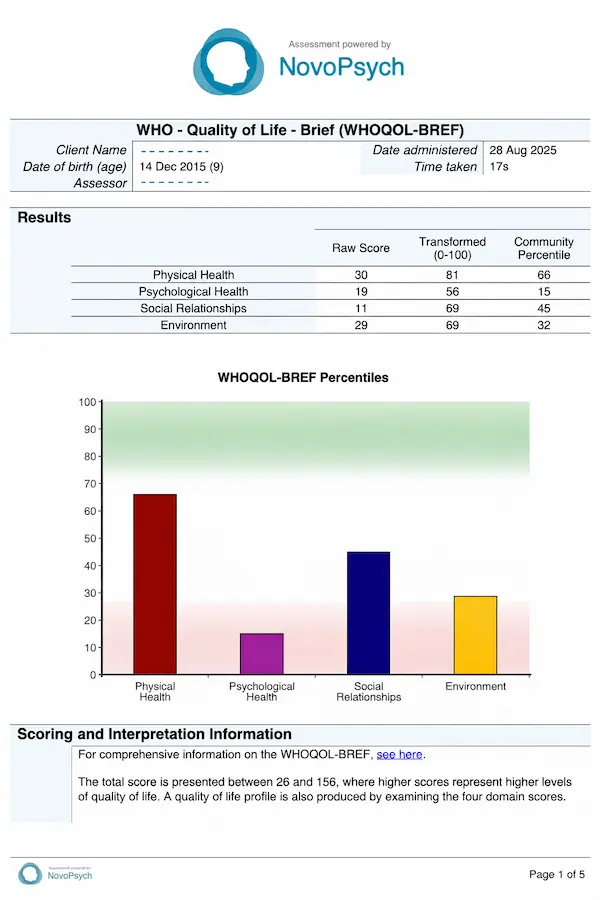
An assessment chart from NovoPsych illustrating raw and transformed scores for Physical Health, Psychological Health, Social Relationships, and Environment, providing a multidimensional view of well-being.The “Subjective Dimension” is critical. Two people might live in identical 300-square-foot studios; one may feel liberated by minimalism, while the other feels trapped by poverty. Therefore, interventions must be personalized. As Scanlon suggests, we must respect the “individual’s point of view” while ensuring they have the objective resources (the “substantive goods”) to thrive.
7. Conclusion: Designing for the Human Spirit
Achieving a high Quality of Life in the 21st century requires a delicate balance between our biological needs, our psychological aspirations, and our environmental realities. Whether we are analyzing the impact of chronic disease or the constraints of urban density, the goal remains the same: to foster an environment where the “Tree of Life” can flourish in all five dimensions.
Future urban planning and personal lifestyle choices must integrate the Biopsychosocial model with philosophical insights like Scanlon’s to ensure that “small spaces” do not lead to “small lives.” By prioritizing “Development,” “Social Connection,” and “Emotional Peace,” we can redefine what it means to live well, regardless of the square footage of our homes.