
1. Introduction: The Art of Urban Flourishing
In an era of rapid global urbanization, the way we inhabit our homes is undergoing a fundamental shift. We are increasingly asking: Can a constrained environment truly support a limitless life? This inquiry is at the heart of the philosophy surrounding Quality of Life in Small Spaces. The importance of this topic stems from the need to transform micro-living from a logistical challenge into an opportunity for human flourishing.
The primary objective of this article is to establish a comprehensive framework for modern dwellers seeking to optimize their Quality of Life in Small Spaces. In doing so, we must address the core research problem of how to define well-being within the physical and material constraints of modern apartments, while also questioning the role of the smart catalyst: to what degree do smart home ecosystems truly enhance personal well-being rather than adding unnecessary complexity?
Furthermore, we examine the resilience factor, exploring how dwellers can shield themselves from external urban stressors to cultivate a fulfilling and peaceful life. By exploring these critical issues, our analysis of Quality of Life in Small Spaces provides a strategic roadmap through six core dimensions, culminating in a blueprint for a more resilient and high-end habitat.
2. Deciphering Quality of Life (QOL)
Quality of Life is a multidimensional concept and metric that transcends basic physical survival to encompass the complex interaction between objective needs and subjective perception. Achieving a high Quality of Life in Small Spaces requires a deep understanding of these layers, as the physical environment directly influences the resident’s psychological and emotional state.
A. Philosophical Perspective: From Aristotelian “Eudaimonia” to Modern Existence
- Eudaimonia: The philosophical roots of QOL trace back to the ancient Greek concept of “Eudaimonia,” which literally translates to being blessed by a benevolent guardian spirit. This foundational idea serves as the starting point for reimagining Quality of Life in Small Spaces.
- Beyond Pleasure: This concept is not limited to fleeting pleasure or happiness; rather, it focuses on the objective realization of a human’s potential across intellectual, imaginative, and emotional faculties. It is a cornerstone of Quality of Life in Small Spaces, as it shifts the focus from the size of the dwelling to the depth of the experience.
- Self-Actualization: Plato argued that QOL is linked to how a person lives and the character they adopt, emphasizing that “flourishing” requires understanding and ordering the parts of the soul (reason, spirit, and appetite). In a modern context, this internal order is essential for maintaining a high Quality of Life in Small Spaces.
- Modern Existence: In the contemporary era, QOL is viewed as a comprehensive assessment of the human experience, where modern policies aim to create opportunities for individuals and societies to thrive over the long term, regardless of their environmental footprint or home dimensions.
B. Socio-Psychological Dimensions: Connection, Belonging, and Mental Clarity
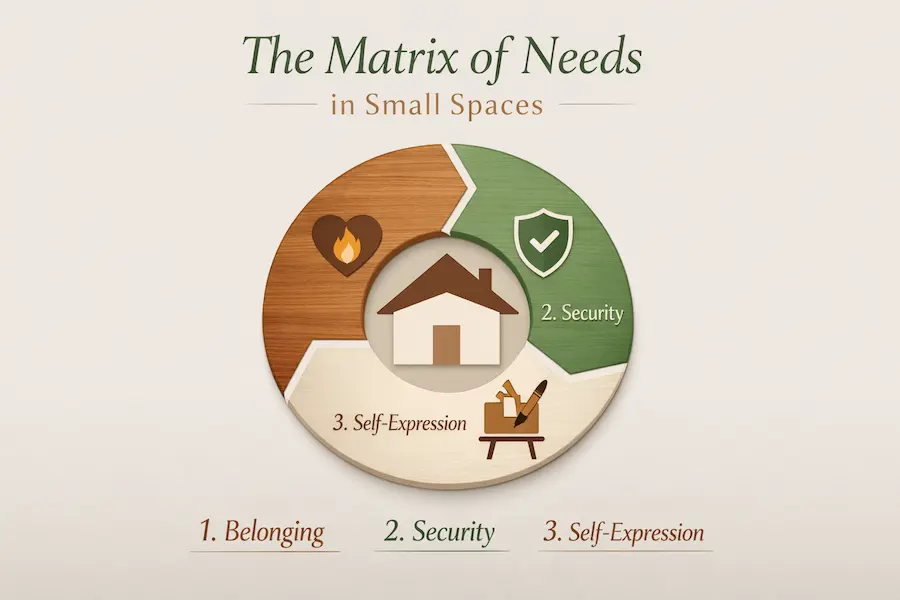
- Basic Human Needs: Quality of Life in Small Spaces is anchored in fulfilling a matrix of needs including belonging, identity, participation, affection, and freedom. This matrix is essential to ensuring that a compact environment does not limit the human experience but rather enhances it.
- Subjective Well-being: Self-reported accounts of happiness and satisfaction play a crucial role, as they reflect the “meaning” or “significance” that individuals assign to their objective circumstances. In the context of Quality of Life in Small Spaces, this subjective lens determines whether a home feels like a sanctuary or a constraint.
- Adaptation and Interaction: QOL is influenced by an individual’s ability to connect with others and feel psychologically secure. However, challenges such as “habituation” exist, where individuals may report satisfaction despite poor conditions simply because they have grown accustomed to them—a critical point to address when striving for a genuine Quality of Life in Small Spaces.
C. The Economic Lens: Quality of Life vs. Standard of Living
The distinction between ‘Quality of Life’ and ‘Standard of Living’ is clearly demonstrated when comparing income against happiness, which is a key debate within the framework of Quality of Life in Small Spaces. This distinction highlights that while financial resources may improve material conditions, they do not automatically translate into a more fulfilling domestic experience unless the living environment is intentionally designed to support human flourishing.
- Shortcomings of Economic Indicators: The Social Indicators” movement arose due to dissatisfaction with purely economic metrics (like GDP), which are aggregate measures that reveal little about the specific details of individual well-being.
- “Income Does Not Guarantee Happiness: Research indicates that increasing an individual’s income does not have a lasting effect on reported happiness levels, making a sole focus on economic growth a ‘narrow’ goal for evaluating social policies. Within the framework of Quality of Life in Small Spaces, this suggests that personal flourishing depends more on the intentionality of the living environment and the satisfaction of psychological needs than on mere financial accumulation.
- Integration of Capitals: To achieve sustainable QOL, investment must be made across four types of capital:
- Human Capital: Knowledge and health.
- Social Capital: Networks and collaborative norms.
- Built Capital: Tools, buildings, and infrastructure.
- Natural Capital: Environmental services (clean air, water).
Summary: Quality of Life is the direct result of how well objective human needs (such as food and security) are met in relation to the subjective perception of well-being (happiness and satisfaction), while accounting for the relative weights individuals place on each need within their specific cultural and temporal contexts.
3. The Genealogy of Well-being: A Historical Context
The concept of well-being, as explored through the lens of Quality of Life in Small Spaces, has evolved from a rigid moral framework into a complex, multidimensional metric that balances objective existence with personal satisfaction. This evolution reflects a broader shift in understanding how the immediate environment serves as a foundation for either human constraint or flourishing.
• The Classical Era: Greco-Roman Foundations
- The Concept of Eudaimonia: In ancient Greek philosophy, well-being was rooted in “Eudaimonia,” which refers to the objective realization of a person’s potential through the exercise of their imaginative, intellectual, and emotional faculties.
- The Flourishing Soul: Plato and Aristotle viewed a ‘good life’ not as a collection of pleasant moments, but as the flourishing of the human soul through the pursuit of virtue and the proper ordering of life’s priorities. This concept serves as the bedrock of Quality of Life in Small Spaces, suggesting that true well-being is achieved through the harmony and intentionality of one’s immediate environment rather than its physical scale.
- Philosophical Duty: Well-being during this era was often linked to how an individual lived and the character they adopted, focusing on the “prosperous” functioning of the self within the community.
• The Middle Ages & The Renaissance: From Survival to Aesthetic Flourishing
- The Shift in Meaning: Over time, the understanding of well-being transitioned from a strictly moral or spiritual “blessing” toward a more integrated human experience. This shift has fundamentally influenced Quality of Life in Small Spaces, as we now view the home as a vital component of this integrated experience.
- Human Potential: During the Renaissance, the focus on “Eudaimonia” evolved to emphasize the actualization of human capabilities and the aesthetic value of life, moving beyond mere survival toward a richer, more expressive existence.
- Objective Development: This period laid the groundwork for viewing life quality through the lens of human development and the pursuit of excellence in various fields.
• The Contemporary Era: The Shift Toward Data-Driven and Subjective Metrics
- The Social Indicators Movement: In the modern era, particularly after the mid-20th century, there was growing dissatisfaction with purely economic measures like GDP, leading to the “Social Indicators” movement to capture the nuances of human welfare.
- Subjective Well-being (SWB): Modern metrics now heavily rely on ‘subjective’ accounts, where individuals report their own levels of happiness and life satisfaction, reflecting the personal ‘meaning’ they find in their lives. This internal appraisal is a core element of Quality of Life in Small Spaces, as it emphasizes that the occupant’s perception of their environment is just as vital as the physical dimensions themselves.
- The Matrix of Needs: Today, Quality of Life (QOL) is analyzed through a comprehensive matrix that includes belonging, identity, and freedom, utilizing data to balance objective conditions with subjective experiences.
- Integration of Capitals: The contemporary approach views well-being as the result of investing in human, social, built, and natural capitals, ensuring a sustainable and comfortable existence.
4. Being & Space: The Ontological Relationship
The relationship between a being and its environment is not merely functional; it is a fundamental ontological bond where space defines the essence of existence. This profound connection is a central theme in our philosophy of Quality of Life in Small Spaces, highlighting how the physical boundaries of our habitat shape the very nature of our being. To understand how these philosophical principles translate into modern structural solutions, one must explore [The Ultimate Guide to Space Optimization 2026: Mastering Vertical Living and AI-Driven Smart Home Layouts], which bridge the gap between ontological needs and functional AI-driven environments, enhancing our capacity to thrive.
• Humanity & Habitat: How Our Surroundings Shape Our Identity
- The Spatial Self: Human identity is inextricably linked to habitat, as the “proper functioning” of a person requires a space that supports their intellectual and emotional faculties.
- The Eudaimonic Environment: Quality of life is realized when our surroundings act as a catalyst for ‘Eudaimonia,’ allowing individuals to actualize their potential within a physical context. This transformative relationship is a major theme in Quality of Life in Small Spaces, as it emphasizes that even the most compact environment can be engineered to foster profound human growth and fulfillment.
- Belonging and Identity: Quality of Life in Small Spaces ensures that a home is more than just a shelter; it is a vital component of the “matrix of needs,” fulfilling deep-seated human requirements for belonging and self-expression.
• Sentient Territoriality and Natural Capital: Reimagining Shared Habitats and Quality of Life in Small Spaces
- The Biological Foundation: Just as humans require specific conditions to flourish, animals operate within a framework of territoriality that ensures survival and reproductive success.
- Natural Capital: Shared habitats are governed by “Natural Capital,” where ecosystem services provide the necessary resources for all living beings to maintain their quality of life.
- The Ecosystem Balance: Recognizing the needs of other species within a shared environment is essential for a sustainable, holistic approach to well-being and spatial planning. Within the framework of Quality of Life in Small Spaces, this balance ensures that our domestic boundaries remain porous and connected to the broader biological community, fostering a sense of harmony that transcends the physical limits of the home.
• The Tech Evolution: How Digital Integration Has Redefined the “Concept of Place”
- The Built Capital Shift: Technological advancement has transformed our “Built Capital,” moving from purely physical structures to integrated smart environments.
- Redefining Boundaries: Digital integration allows small spaces to transcend their physical limits, redefining ‘place’ as a hub of global connectivity and multi-functional utility. This technological expansion enables a compact dwelling to function as a gateway to the world, ensuring that physical constraints do not result in social or professional isolation.
- Efficiency and Well-being: The evolution of smart technology—from automated systems to intelligent appliances—aims to reduce the friction of daily life, directly enhancing subjective well-being. To discover the specific tools that facilitate this lifestyle, refer to our comprehensive review of the [Best Smart Home Devices for Small Spaces 2026: Ultimate Guide to Compact Living Tech], where efficiency meets modern well-being.
• The Luxury Paradox: Redefining “High-End” Living in Compact Environments
- Quality over Quantity: In the modern context, luxury is being redefined; it is no longer about vast square footage, but about the “quality” and “intelligence” of the space.
- The Aesthetic of Flourishing: High-end living in compact environments focuses on the ‘aesthetic flourishing’ of the individual, where every element is curated to support a comfortable and meaningful life. This meticulous curation is Quality of Life in Small Spaces in action, demonstrating that beauty and functionality must converge to create an environment that elevates the human spirit.
- Sustainable Luxury: The new paradox of luxury lies in the efficient use of resources (Natural and Built Capital) to create an environment that feels expansive and “premium” regardless of its size.
Watch: An insightful deep dive into the 2026 economic landscape of wellbeing, highlighting why ‘Quality of Life’ has become the ultimate metric for success in small-space urban living.
5. The Psychology of Limited Spaces: Perception & Impact
The psychological experience of space is not merely a reaction to physical dimensions, but a complex interaction between the environment and the human psyche. According to The Philosophy of Quality of Life in Small Spaces, the mental perception of a dwelling can expand or contract its perceived boundaries, making the psychological design of a home as critical as its physical architecture.
• Spatial Perception: Navigating the Boundaries of Small Environments
- The Subjective Nature of Space: As emphasized by Costanza et al., Quality of Life (QOL) is not only about objective conditions but is heavily weighted by subjective perceptions. In small environments, space is “perceived” based on how well it satisfies the individual’s needs, rather than its actual square footage.
- Mental Expansion: In the context of ‘Eudaimonia’ as discussed by Broom, the mind requires a habitat that does not obstruct the exercise of its faculties. A limited space must be designed to offer visual clarity, preventing cognitive overload and supporting what Broom describes as the ‘objective realization’ of potential. This pursuit of mental expansion is a key pillar of Quality of Life in Small Spaces, asserting that intellectual freedom can be maintained even within physical boundaries through intentional environmental design.
• The Stress of Confinement vs. The Comfort of “Cocooning”
- The Confinement Threshold: According to the framework provided by Costanza et al., when a habitat fails to meet the fundamental “matrix of human needs”—such as the need for freedom and identity—it transforms from a sanctuary into a source of stress.
- Habitual Adaptation: Cummins highlights a critical psychological phenomenon: ‘adaptation.’ Individuals may report satisfaction in limited spaces due to a psychological defense mechanism where they habituate to their conditions. However, for true well-being, the space must transcend mere ‘survival’ to provide a sense of security and intimacy. Within Quality of Life in Small Spaces, acknowledging this mechanism is vital to ensure that design goes beyond baseline comfort to achieve authentic psychological flourishing.
- The “Cocooning” Effect: Drawing from Broom’s analysis of the flourishing self, a small space can become a “protective shell” that fosters aesthetic flourishing. This occurs when the individual perceives the space as a controlled territory that reflects their identity and “Logos”.
• Behavioral Impact: How Compact Living Influences Daily Life
- The Efficiency-Well-being Link: Cummins notes that subjective well-being is often tied to the “meaning” and “importance” we assign to our activities. In a compact home, the efficiency of daily routines—facilitated by smart integration—reduces environmental friction, thereby preserving the individual’s mental energy.
- Territoriality and Social Capital: Within the household, shared habitats require clear boundaries to maintain what Costanza et al. define as ‘Social Capital’—the networks and norms that facilitate cooperation. Small spaces demand a higher level of social coordination to ensure every inhabitant can flourish without conflict. As explored in Quality of Life in Small Spaces, the strategic management of territory and the establishment of shared protocols are essential to transforming physical proximity into a source of social strength rather than friction.
6. External Forces & Resilience
Resilience and External Pressures: Living in a compact environment is not an isolated experience; it is constantly shaped by external social and environmental pressures that require a high degree of resilience. This concept is central to Quality of Life in Small Spaces, as it emphasizes that a truly successful dwelling must not only provide internal comfort but also empower its inhabitants to adapt and thrive amidst the shifting dynamics of the outside world.
• Social Challenges: Overcoming the Stigma and Isolation
- The Social Capital Dimension: Costanza et al. define “Social Capital” as the web of relationships and norms that facilitate cooperation within a community. In the context of apartment living, building this capital is essential to overcome the potential for social isolation and the stigma sometimes associated with smaller, high-density dwellings.
- Perception of Status: Cummins argues that subjective well-being is influenced by how individuals perceive their standing relative to social norms. Overcoming the stigma of ‘small living’ requires a psychological shift—viewing the home not as a sign of limited means, but as a deliberate, ‘Eudaimonic’ choice for a more focused and intentional life. This paradigm shift is at the heart of Quality of Life in Small Spaces, as it seeks to redefine luxury not through square footage, but through the quality of experience and the intentionality of one’s environment.
• Environmental Impact: Managing Noise, Light Pollution, and Air Quality
- The Built vs. Natural Capital: Costanza et al. highlight the tension between “Built Capital” (our buildings and infrastructure) and “Natural Capital” (the ecosystem services like clean air and quiet environments). In urban, compact settings, the quality of life is often threatened by “negative externalities” such as noise and light pollution.
- The Requirement for Flourishing: For a being to achieve what Broom describes as ‘proper functioning,’ the environment must provide a baseline of physical health. Managing air quality and acoustic comfort is not just a matter of convenience; it is a fundamental requirement for the ‘objective realization’ of an individual’s potential. Within Quality of Life in Small Spaces, these environmental factors are treated as essential infrastructure for the soul, ensuring that the physical density of the space does not compromise the biological or cognitive integrity of the inhabitant.

• Sustainable Flourishing: Aligning Micro-living with Global Goals
- The Matrix of Sustainability: Costanza et al. emphasize that sustainable well-being is achieved when we satisfy human needs while maintaining the integrity of natural systems. Micro-living inherently aligns with these goals by reducing the “ecological footprint” of the built environment.
- Ethical Flourishing: Broom suggests that true flourishing involves living in a way that respects the broader biological and environmental context. By choosing a compact, efficient lifestyle, individuals contribute to ‘Global Sustainability,’ ensuring that their personal quality of life does not come at the expense of future generations or the planet’s health. This alignment between personal well-being and planetary responsibility is a core tenet of Quality of Life in Small Spaces, positioning the micro-living movement as an ethical response to the macro-challenges of our era.
To learn more about international standards for urban development, visit UN-Habitat – A Better Urban Future.
7. Implementing Quality of Life in Small Spaces: The 7 Pillars Framework
Under the umbrella of Quality of Life in Small Spaces, these seven pillars serve as the definitive framework for mastering small-space living:
- Philosophical Intentionality: Defining the purpose of every inch for “Eudaimonic” realization.
- Intelligent Built Capital: Using technology to reduce environmental friction and expand spatial utility.
- Spatial Flow & Harmony: Designing for visual continuity and multifaceted utility in a compact habitat.
- Natural Capital Connection: Integrating biophilic elements is essential for biological and psychological health, as practical interventions like natural light and greenery foster resilience in compact interiors. This integration is explored in “Biophilic Design and Quality of Life: Cultivating Mental and Physical Well-being in Compact Spaces,“ which demonstrates how natural capital reduces stress and restores cognition in urban living.
- Cognitive clarity is about reclaiming mental space through deliberate systematization and thoughtful organization. By applying these principles to modern living environments, individuals can transform compact spaces into sanctuaries of focus and efficiency. For a deeper exploration, see our comprehensive guide Cognitive Clarity and Quality of Life: Reclaiming Mental Space through the Organization of Compact Spaces, where the connection between mental focus and spatial order is fully articulated.
- Sensory Comfort: Engineering light, sound, and air to support “subjective well-being”. In compact living environments, sensory comfort emerges as a decisive factor in shaping human experience. The integration of Human-Centric Lighting (HCL) demonstrates how engineered illumination can align with circadian rhythms, reduce stress, and enhance productivity. Yet light is only one dimension of a broader sensory ecosystem. Acoustic engineering ensures that soundscapes minimize noise fatigue and foster mental clarity, while ventilation and air-quality systems regulate oxygen flow, humidity, and pollutant levels to sustain physical health. Together, these three pillars—light, sound, and air—form a holistic framework of sensory comfort. They transform confined interiors into restorative environments where subjective well-being is not compromised by spatial limitations but actively nurtured through design. This perspective directly connects to the principles outlined in Human-Centric Lighting in Compact Spaces and sets the stage for Sensory Comfort: Engineering the Soundscape in Compact Spaces, where acoustic design complements lighting and ventilation to enhance the overall Quality of Life in small urban environments. Ultimately, this progression culminates in the essential physiological foundation of Engineering the Airscape: Ventilation and Indoor Air Quality in Compact Spaces, which anchors the broader philosophy of sustainable comfort in compact architecture.
- Adaptive Resilience: Creating an evolutionary habitat that grows with the dweller’s personal potential.
Conclusion: Toward a New Paradigm of Urban Flourishing
The journey through Quality of Life in Small Spaces reveals that quality of life is not a product of expansive physical boundaries, but a deliberate synthesis of intentionality, technology, and resilience. It is an invitation to redefine our relationship with the environments we inhabit, proving that through thoughtful design and psychological shift, a compact dwelling can become the ultimate foundation for a rich and expansive human experience.
• Resolving the Research Problem: Defining QOL in Micro-Living
The central challenge of this research was to define Quality of Life (QOL) within the material constraints of micro-living. As established by Costanza et al., QOL is the result of meeting a complex matrix of human needs—ranging from basic security to the higher needs of identity and freedom—while balancing objective conditions with subjective satisfaction. In apartments and small spaces, QOL is redefined as the ‘efficiency of flourishing,’ where the limited environment is optimized to support the ‘proper functioning’ of the individual’s intellectual and emotional faculties, a concept rooted in the Aristotelian ‘Eudaimonia’ within Quality of Life in Small Spaces.
• The Smart Catalyst: Technology as a Vector for Well-being
To what degree do smart home ecosystems truly enhance personal well-being? The evidence suggests that technology acts as a vital ‘Built Capital’ that compensates for spatial limitations. By automating mundane tasks and reducing ‘environmental friction,’ smart ecosystems directly boost ‘subjective well-being’ as defined by Cummins, by allowing individuals to focus their mental energy on activities they deem meaningful and important. However, the degree of enhancement depends on ‘seamless integration’—where technology serves the human ‘Logos’ rather than becoming an additional source of cognitive clutter—a key lesson from Quality of Life in Small Spaces.
• The Resilience Factor: Shielding Against External Stressors
Dwellers can shield themselves from external stressors by cultivating ‘Adaptive Resilience.’ This involves a dual strategy: first, the physical management of ‘Natural Capital’ (e.g., air quality and noise control) to ensure biological health; and second, the psychological reclaiming of ‘territoriality.’ As Broom suggests, when individuals view their compact home as a controlled sanctuary for ‘aesthetic flourishing,’ they develop a psychological buffer against the social stigmas and urban pressures of high-density living—a foundational principle of Quality of Life in Small Spaces.
• Future Horizons: Directions for Research
The exploration of Quality of Life in Small Spaces opens several avenues for future scholarly inquiry:
- The Ethics of Micro-Living: Further research is needed to examine the long-term impact of compact living on the “Social Capital” of urban communities.
- Biophilic Tech-Integration: Exploring how smart technology can better mimic “Natural Capital” (such as circadian lighting and simulated natural airflows) to improve health in windowless or restricted environments.
- Adaptive Habituation: Investigating the “habituation” thresholds discussed by Cummins to determine at what point adaptation to small spaces stops being a resilient trait and starts becoming a detriment to human potential.
In finality, the ‘7 Pillars’ proposed in this article serve as a foundational guide for the modern dweller to transform a constrained space into a limitless habitat for the soul—proving that the quality of our lives is truly measured by the quality of our thoughts and the intentionality of our environment. To see these principles in action, explore The Ultimate Small Space Lifestyle Guide 2026: Mastering AI Tech and Modern Comfort, where we delve into the practical tools and technologies that define the modern urban experience.
References
- Aristotle (2009). The Nicomachean Ethics. Oxford University Press, United Kingdom, Revised Edition.
- Bognar, G. (2005). The Concept of Quality of Life. Social Theory and Practice.
- Broom, D. M. (2014). Sentience and Animal Welfare. CABI Publishing, United Kingdom, 1st Edition.
- Costanza, R., et al. (2007). Quality of Life: An Approach Integrating Opportunities, Human Needs, and Subjective Well-Being. Elsevier Science, Netherlands, 2nd Edition.
- Cummins, R. A. (1996). The Domains of Life Satisfaction: An Attempt to Order Chaos. Springer Nature, Germany, 3rd Edition.
- Hobbs, A. (2018). Philosophy and the Good Life. Journal of Philosophy in Schools.
- Jauss, H. R. (1982). Toward an Aesthetic of Reception. University of Minnesota Press, USA, 1st Edition.
- Nussbaum, M. & Sen, A. (1993). The Quality of Life. Clarendon Press, Oxford, 1st Edition.
- Pallasmaa, J. (2012). The Eyes of the Skin: Architecture and the Senses. John Wiley & Sons, United Kingdom, 3rd Edition.
- Ventegodt, S., et al. (2003). The Integrative Quality of Life (IQOL) Theory. The Scientific World Journal.