Today we treat the bathroom as an ordinary part of the house, yet the history of the bathroom is surprisingly short and full of surprises. For most of the history of the bathroom, there was no such room. People washed in rivers, shared public baths, and relied on pits, buckets, and chamber pots. The private, plumbed, tiled room we take for granted is a very recent development, and it is still not universal, even in the most developed nations.
This guide follows the evolution of the bathroom from ancient palaces to the spa-style retreats of the twenty-first century. It draws on four reference works: Alexander Kira’s classic study The Bathroom, Joseph Baxter’s The Essential Bathroom Book, Steven Soifer’s paper The Evolution of the Bathroom and the Implications for Paruresis, and the Better Builders guide The Complete Guide to Creating a Dream Bathroom. Along the way you will see how technology, privacy, and changing ideas about cleanliness shaped home bathroom design and the modern bathroom we know today.
Why the History of the Bathroom Matters
Kira makes a point that frames this whole story: the ways people cope with personal hygiene have varied enormously from one culture and era to another, and the most important factors have been philosophical, psychological, and religious attitudes toward the body, not just available technology. In other words, a bathroom is never only plumbing. It reflects what a society believes about privacy, modesty, health, and status.
Kira also notes a clear pattern. As a society grows wealthier, facilities begin as communal public baths, then move to neighborhood baths, then to a weekly family bath, and finally to private baths in individual homes. Water supply, fuel, and transport decide how fast each step happens. Keeping that pattern in mind makes the history of the bathroom much easier to follow, and it explains the evolution of the bathroom better than any single invention.
Before the Bathroom: Nomads, Rivers, and Early Settlements
Every account of the history of the bathroom has to begin with a world that had no bathrooms at all.
Soifer explains that early humans needed no bathrooms at all. Without permanent settlements, people relieved themselves outdoors and covered their waste with earth. Once communities put down roots and built dwellings, waste disposal became a real problem. The first facilities were built outside the home. Eventually they moved indoors, but moving a toilet inside was not enough, because odors quickly became overwhelming, so builders began to develop methods of dealing with them.
Washing was equally basic. Baxter points out that our most ancient ancestors used a primitive kind of shower, standing under natural waterfalls to scrub themselves clean. Those without a waterfall nearby rinsed with a bucket of icy water.
Ancient Civilizations: Surprisingly Advanced Sanitation
Several early civilizations handled waste in remarkably sophisticated ways. This chapter of the evolution of the bathroom is often a shock, because later centuries went backward.
- Mesopotamia: Soifer reports that the palace of Sargon I, king of Sumer, had six primitive toilets around 3000 B.C.E.
- The Indus Valley: The Harappans built indoor toilets in private homes that fed underground drains flowing into cesspools.
- Minoan Crete: The Palace of Knossos, a complex of more than 1,400 rooms, had flush toilets powered by gravity and a rainwater pipe system. Kira dates the earliest known modern hygiene facilities there to roughly 2000 B.C.; Baxter gives about 1700 B.C. Either way, the first flushing toilet is around 4,000 years old.
- Egypt: Egyptians appear to have used sit toilets, with sand covering waste in a chamber below.
Roman Baths and Public Toilets
The Romans drew on the Etruscans, who had built the largest sewer of the ancient world, and created an elaborate drainage network. Wealthy Romans could connect their homes to it, while everyone else used public facilities. Soifer notes that by the fourth century C.E. there were more than 140 of them. In ruins in Tunisia, the seats were cut into marble ledges on three sides with no dividers, and water flowing beneath carried the waste away. People paid to use them, and the rooms doubled as places for socializing, politics, and business.
Bathing was just as public. Baxter notes that the Romans built and maintained elaborate warm public baths, supplying 300 gallons of water per person per day. In Kira’s words, from the time of the Roman Empire through the eighteenth century, bathing was a public activity, sometimes communal and sometimes familial. Rome even gave us the public urinal, the “Vespasienne,” named for the emperor who sold the collected urine as dye.
The Middle Ages: A Thousand Years of Setbacks
Soifer observes that almost a thousand years passed between the fall of Rome and the restoration of public and, to a large degree, private toilet facilities in Europe. Constantinople kept the Roman tradition of public sewage disposal alive, but elsewhere things deteriorated.
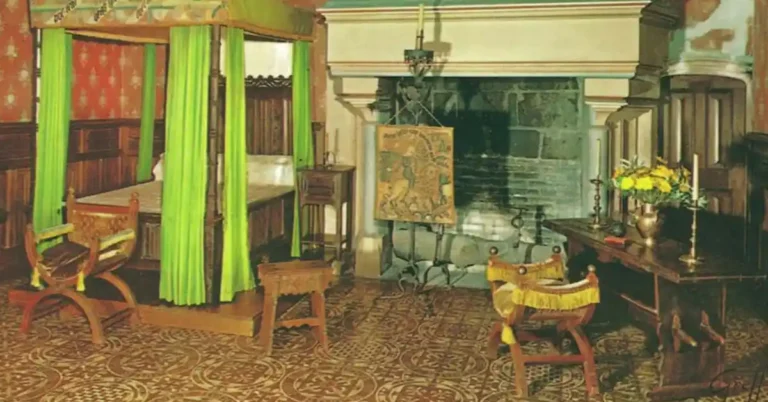
Medieval castles used “garderobes,” privies with a few seats projecting from the wall so that waste fell into the moat or collectors below. Kira adds a fascinating detail: toilets were often built high in turrets and towers, partly because chutes could empty into the moat, and partly in the belief that elevation placed the act closer to heaven. Monasteries, meanwhile, often had elaborate water and sewage systems.
Ordinary people fared worse. Baxter describes public privies of plain wooden planks built over deep pits, where rotten boards sometimes sent unlucky users into the pit. Most households relied on chamber pots, which ranged from humble clay jars to ornate china, and how decorated a pot was signaled the owner’s wealth. When a pot was emptied from an upper window, politeness required shouting a warning. Baxter claims the French “Gardez l’eau” (“watch out for the water”) turned into the British word “loo.”
Soap did not reach England until the fourteenth century, and before that people used scented “toilet waters.” Crusaders returning from the Arab world did spark fresh interest in sanitation, and Soifer notes evidence of manned public facilities in parts of Europe by 1214.
Privacy Is a Modern Invention
One of the most surprising lessons in the history of the bathroom is that privacy in the toilet is a very new idea. Soifer traces it to the nineteenth century and ties it to prosperity and religious attitudes. Before that, using the toilet was often a family affair, with enough seats for everyone. Kira quotes an account that kings, princes, and generals treated elimination as a “throne” at which audiences were granted. Louis XIV is said to have announced his marriage to Madame de Maintenon from his throne.
Bathing was social too. Kira notes that in the seventeenth century, ladies and gentlemen had private bathtubs, often designed for two, and entertained while bathing, sometimes even having their portraits painted in the tub. Whole families still bathe together in many parts of the world. Modesty, as Kira puts it, needs the right conditions before a society can turn it into a virtue.
The Water Closet Arrives: 1596 to the Victorian Era
The sixteenth century was a turning point. Soifer reports that in 1519 the Normandy government required toilets in every home. Then, in 1596, Sir John Harington of England built the water closet for his godmother, Queen Elizabeth I. Baxter’s account says Harington was mocked for his invention and made only one model, and Baxter adds that the toilet did not catch on for roughly another 200 years. Soifer agrees that the WC, essentially the Knossos design with moving parts, only became popular in the late 1700s. Baxter also says Elizabeth had a valve water closet fitted in her room in 1598, a small discrepancy between sources that shows how murky early dates can be.
The Toilet Becomes Modern
The history of the toilet is really a chain of small inventions. A string of inventors then turned the water closet into the fixture we know. These milestones in the history of the toilet are worth knowing:
- The S-bend: Baxter credits a watchmaker named Cumming with inventing the curved tube of standing water that keeps sewer odors out of the house.
- The one-piece toilet: In 1885, Thomas Twyford produced a one-piece model that no longer needed a supporting wooden case.
- Thomas Crapper: Soifer credits Crapper with the design still used today in the 1850s, but Baxter cautions that he was a successful plumber, not the inventor of the toilet.
- Toilet paper: The Scott brothers introduced it as we know it in 1879, after centuries of leaves, shells, sponges on sticks, lace, and newspaper.
The Victorians added their own twists. Baxter writes that many Victorian ladies first saw a flushing toilet at the Great Exhibition of 1851 and were offended by the reflection of their own behinds, so patterned bowls became the accepted norm.
The Great Exhibition and the Public Restroom
Soifer argues that nothing stimulated the growth of public restrooms as much as the Crystal Palace Exhibition of 1851. About 800,000 people paid to use the facilities, which had to be built on an unprecedented scale. Railways and later automobiles spread the idea further, creating demand for toilets in terminals, gas stations, and highway rest areas. Paris pioneered men’s public urinals in the 1840s and enclosed kiosks for women in the 1860s.
Sanitation lagged behind plumbing. Soifer notes that the first sewage treatment in world history only occurred in 1889, and until then most sewage flowed through open gutters. Cities had to build water supplies and sanitary disposal systems before the home bathroom could exist, which Baxter confirms: by the end of the nineteenth century the sink, the bathtub, and the toilet were moving inside the house.
Bringing the Bath and Shower Indoors
Before indoor plumbing, washing was a performance. Baxter describes pumping water by hand, carrying twenty or thirty gallons to the stove, heating it, and filling the tub. The father washed first, then the children from cleanest to dirtiest, and the mother last. The water was then carried out bucket by bucket. No wonder bathing was not taken lightly.
The Strange Early Shower
Showers began to appear in homes in the eighteenth century. The earliest design, according to Baxter, stood over 12 feet high, was made of metal painted to look like bamboo, and recirculated the same water again and again. In the 1830s, America produced the Virginia Stool Shower, a walnut contraption with a revolving seat and a foot pedal that worked a scrubbing brush. By 1889, the J. L. Mott Iron Works offered a showering system with needle sprays, a descending douche, and a bidet bath, with exposed pipes forming a shield around the bather. Shower design then settled into the single head until the 1980s, when the vertical whirlpool revived the same luxury.
The Twentieth Century: The Standard Bathroom Takes Shape
No chapter in the evolution of the bathroom was more important for ordinary families than the twentieth century.
The three-fixture, five-by-seven-foot bathroom is still the norm in the United States. Kira dates it to the building boom of the early 1920s, when virtually all new urban residential construction was required by law to include at least one private bath per dwelling. Soifer adds that it first appeared in hotels in the early 1900s, when a New York State hotelier advertised “A Room and a Bath for a Dollar and a Half.”
The 1920s were also a time of elegant, lavishly equipped custom bathrooms for wealthy patrons. After the Depression and World War II, standards stayed at a minimal level for decades. Kira observes that during the 1930s and after the war, several ingenious prefabrication schemes were proposed, but few ever reached practice. The result was that the average bathroom of his day was barely distinguishable from one built forty years earlier.
From Utility Room to Retreat
Change came gradually. Soifer notes that the 1960s construction boom made more than one bathroom per household normal, and in the 1970s Americans began to treat the home bathroom as more than an essential, leading to larger rooms and more elaborate design. Kira had predicted that if the fifties and sixties were the era of the kitchen and family room, the seventies might be the era of the bathroom and body care, since the bathroom remained the single most underdeveloped area of the average house.

The Modern Bathroom: Spa, Wellness, and Sustainability
Baxter observes that modern homes may have two or three bathrooms plus a guest bath, that en-suites are now a normal part of life, and that hot tubs and whirlpool baths have made bathing as social as it was in Roman times. The Better Builders guide shows how far that shift has gone. Its starting point is the dream of a tranquil, spa-like haven in which every detail fosters relaxation, with water conservation and planning for aging as key considerations.
Key Features of a Modern Bathroom
Today’s home bathroom design and modern bathroom planning a menu of features that would have astonished a Victorian homeowner:
- Freestanding tubs and steam showers with multiple shower heads, offered as upgrades for a spa feel.
- Heated floors for comfort, especially in additions and primary suites.
- Smart storage such as floating cabinets, wall-mounted units, built-in shower niches, and benches.
- Anti-scald valves that balance pressure so the water temperature stays stable when someone uses water elsewhere in the house.
- Hot water recirculation systems that stop gallons of cold water from running down the drain while you wait for heat.
- Low-maintenance materials chosen for easy cleaning, along with accessibility features for aging in place.
Infrastructure Matters Too
The guide reminds us that most plumbing is hidden, which is why leaks come as a surprise. In an older home, galvanized pipes can accumulate mineral deposits, reduce water pressure, and eventually fail. A renovation is the best moment to upgrade that infrastructure, waterproof properly, and bring plumbing up to code. It is a modern echo of the very old lesson that the best bathroom starts with good water supply and drainage.
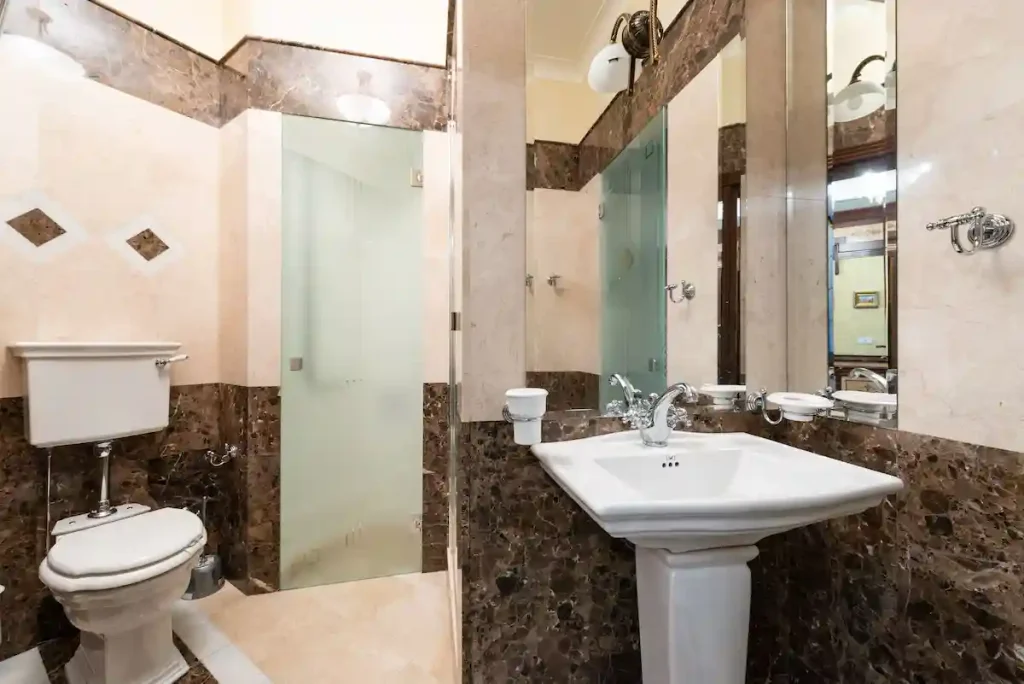
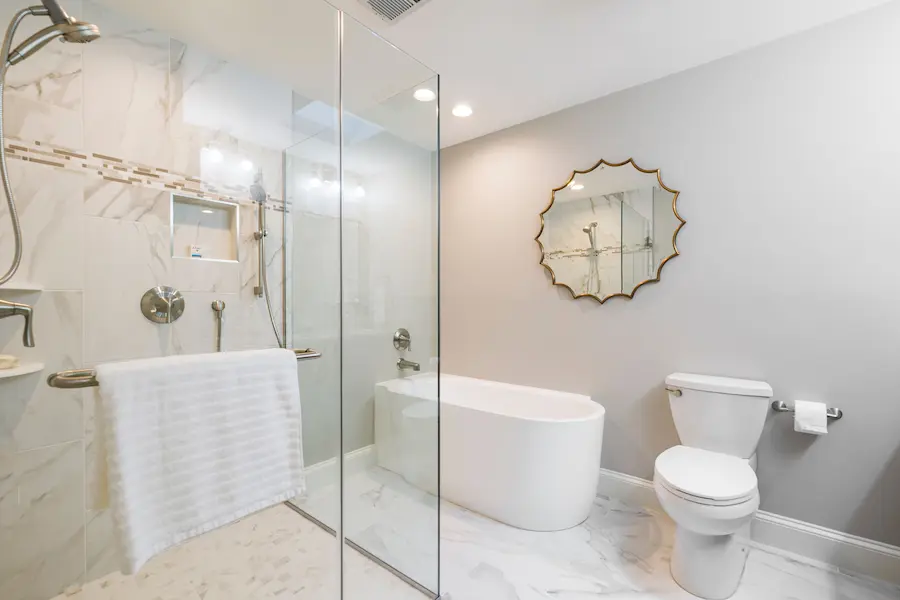
A contemporary residential bathroom illustrating the culmination of the history of the bathroom, combining dedicated sanitation fixtures.Bathroom Culture: Privacy, Cleanliness, and Design
Any history of the bathroom must also explain culture, because home bathroom design follows social attitudes as much as engineering.
Soifer and Kira both show that home bathroom design is tied to psychology. The home bathroom is often the only truly “off-bounds” room in a house, and it offers privacy that lowers embarrassment and shame. Soifer lists the features that make privacy work in design: a discreet location, discreet identification, visual barriers or compartments, and masking sounds such as piped-in music. Customs still differ. European water closets are fully enclosed, while American public stalls typically leave a gap above and below.
Ideas about cleanliness evolved too. Kira notes that body cleansing has always had ritual and symbolic meaning, from washing hands at communion to bathing in the Ganges. Even today, much of our attention to grooming reflects social pressure as well as hygiene.
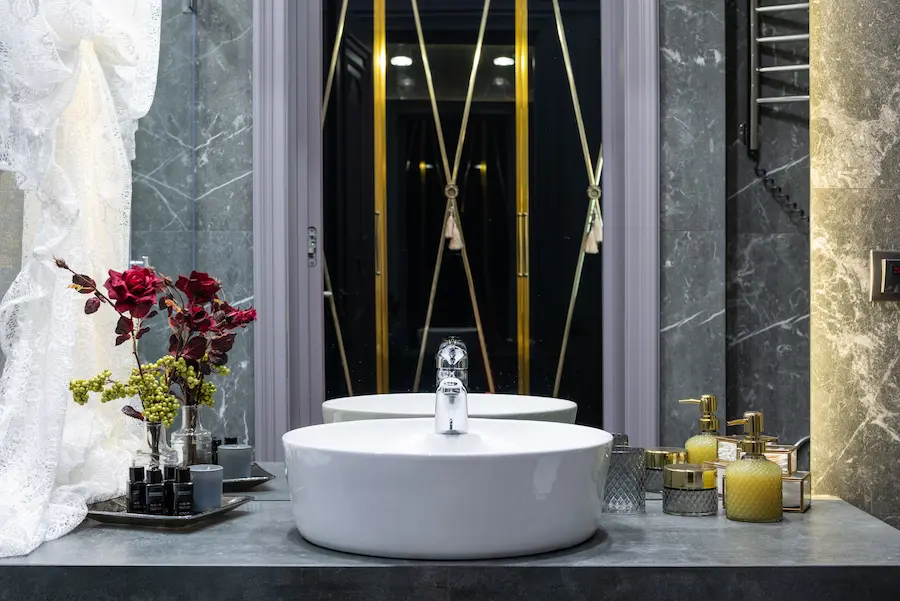
An ornate modern bathroom vanity with a round vessel sink, gold-lined mirror accents, and decorative accessories, reflecting aesthetic indulgence in the history of the bathroom.Timeline: The Evolution of the Bathroom at a Glance
- c. 3000 B.C.E.: Sargon’s palace in Mesopotamia has six toilets; Indus Valley homes have indoor toilets and drains.
- c. 2000–1700 B.C.E.: Flush toilets at the Palace of Knossos.
- Roman era: Sewers, public baths, and more than 140 public toilets by the fourth century C.E.
- Middle Ages: Garderobes, chamber pots, and a long gap in sanitation in Europe.
- 1596: Harington’s water closet.
- 1830s–1889: Virginia Stool Shower, Twyford’s one-piece toilet, Mott’s multi-spray shower.
- 1851: Great Exhibition drives public restroom growth.
- 1920s: The three-fixture, 5×7 bathroom becomes standard.
- 1960s–1970s: Multiple bathrooms per home; larger, more decorative rooms.
- Today: Spa-style, sustainable, accessible design.
Frequently Asked Questions About the History of the Bathroom
When was the first indoor bathroom built?
The earliest known sophisticated facilities date to around 2000 B.C.E. at the Palace of Knossos on Crete, with sources giving dates between roughly 2000 and 1700 B.C.E. Indoor toilets also existed in Indus Valley homes.
Who invented the water closet?
Sir John Harington of England built the first modern water closet in 1596. Thomas Crapper later became famous as a plumber but did not invent the toilet.
When did bathrooms become common in homes?
Fixtures moved indoors in middle-class urban homes by the end of the nineteenth century, and the standard private bathroom became widespread with the building boom of the early 1920s.
How big is the standard bathroom?
The three-fixture, five-by-seven-foot bathroom has been the standard in the United States since the early twentieth century, although larger designs became popular from the 1970s.
Conclusion
The history of the bathroom is a story of water, technology, and changing attitudes. Ancient palaces had flush toilets, medieval Europe lost them, the Victorians rediscovered them, and the twentieth century made a standard private bathroom a legal minimum. Only in the last fifty years has the home bathroom become a place for comfort and wellness rather than a purely functional closet.
If you are planning a renovation, the lesson from the evolution of the bathroom is simple. Start with infrastructure, plan for privacy and accessibility, and then add the touches that make the space a daily retreat. The history of the bathroom shows that a modern bathroom is the result of thousands of years of experiments, and the evolution of the bathroom will keep going as our ideas about comfort change.
References
- Kira, Alexander. The Bathroom. Viking/Penguin.
- Baxter, Joseph. The Essential Bathroom Book. Summersdale Publishers, 2004.
- Soifer, Steven. The Evolution of the Bathroom and the Implications for Paruresis. International Paruresis Association, 2000.
- Better Builders. The Complete Guide to Creating a Dream Bathroom: From Outdated to Oasis. betterbuilders.com.