The history of interior design is far more than a story of furniture, colors, and decoration. It is a reflection of human civilization itself. Every period in history has left a distinct mark on interior spaces, shaping how people lived, worked, worshiped, and expressed social status. From prehistoric shelters to smart homes, interior environments have evolved alongside technological progress, cultural values, artistic movements, and changing lifestyles.
Understanding the history of interior design reveals how societies transformed raw spaces into meaningful environments. Ancient civilizations emphasized functionality and symbolism, medieval communities focused on protection and religious influence, Renaissance designers celebrated beauty and proportion, while modern designers embraced simplicity and innovation. Today, interior design combines lessons from centuries of development with advanced technology and sustainability.
This journey through the history of interior design explores the major periods that shaped interiors across the world and explains how historical influences continue to inspire contemporary residential and commercial spaces today.
Prehistoric and Primitive Interior Design
The earliest chapter in the history of interior design begins with prehistoric communities. Human shelters were initially built for protection against weather, animals, and environmental dangers. Interior spaces were simple, practical, and closely connected to daily survival.
According to the source material, early civilizations such as the Mesopotamians, Chinese, and Aztecs developed distinct domestic environments that reflected available resources and social structures.
Mesopotamian Interiors
Ancient Mesopotamians constructed homes primarily from sun-dried mud bricks. Wealthier families lived in two-story houses organized around central courtyards, while craftsmen and traders occupied simpler structures. Homes commonly included kitchens with fireplaces, guest reception rooms, bedrooms, and even drainage systems. Furniture featured upholstery, carved animal-inspired forms, and decorative inlays.
Ancient Chinese Interiors
Chinese houses were constructed using baked bricks and featured practical yet sophisticated architectural solutions. Noble residences included colored glass windows, marble staircases, and fireplaces. A defining feature was the Kang, a raised heated platform used for sleeping and daily activities. Low tables, carved cabinets, and elegant furnishings demonstrated a growing appreciation for comfort and aesthetics.
Aztec Interiors
Aztec homes were relatively simple structures made of adobe and thatch. Unlike many other civilizations, furniture played a limited role. People commonly slept on mats and stored food in clay containers. Artistic expression appeared primarily through decorations, statues, and ceremonial objects.
These early examples show that the evolution of interior design began with functional needs before gradually incorporating beauty, symbolism, and social identity.
Interior Design in the Ancient World
The ancient world introduced many design principles that remain influential today. Egyptian, Greek, and Roman civilizations established standards for furniture, ornamentation, spatial organization, and architectural harmony.
Ancient Egyptian Interiors
Ancient Egypt was among the first civilizations to develop richly decorated interiors. Large temples featured hypostyle halls, painted walls, carved surfaces, courtyards, and loggias that connected indoor and outdoor environments. Furniture included stools, chairs, beds, tables, and headrests with decorative inlays and curved legs.
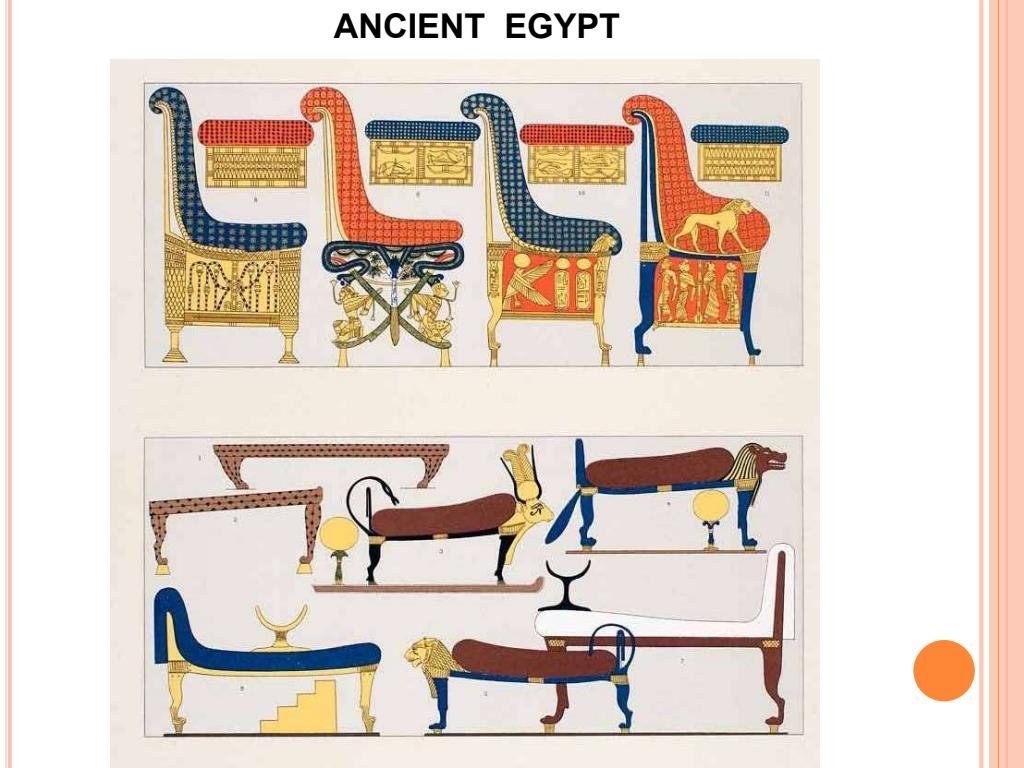
Egyptians viewed interior spaces as expressions of power, religion, and permanence. Their use of symbolism, color, and craftsmanship influenced numerous later design styles.
Ancient Greek Interiors
Greek design emphasized balance, proportion, and elegance. Buildings often used stone construction while interiors featured painted pottery, textiles, decorative vessels, and carefully designed furnishings. The famous Klismos chair, recognized for its graceful, curved legs and ergonomic form, remains one of the most admired furniture designs in history.
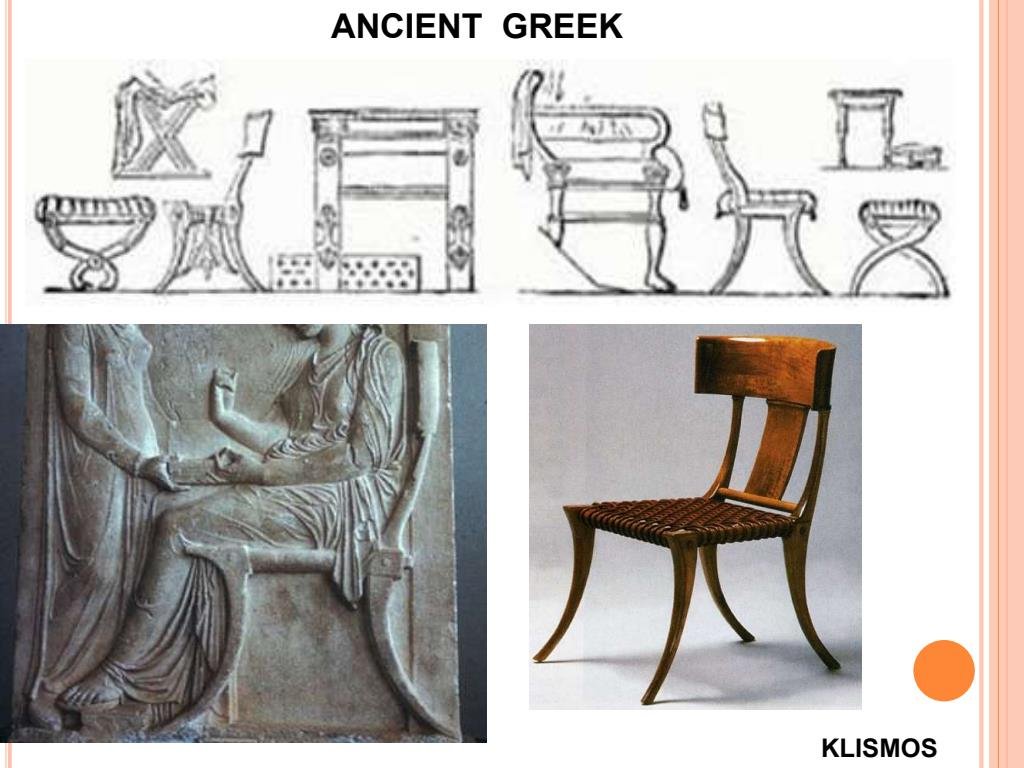
Greek interiors demonstrated how beauty could emerge from simplicity and mathematical harmony.
Ancient Roman Interiors
Roman designers expanded upon Greek ideas while introducing advanced engineering solutions. Houses were organized around atriums and courtyards, creating structured interior layouts. Wealthy Romans used marble inlays, mosaics, frescoes, and decorative furnishings to communicate status and sophistication.
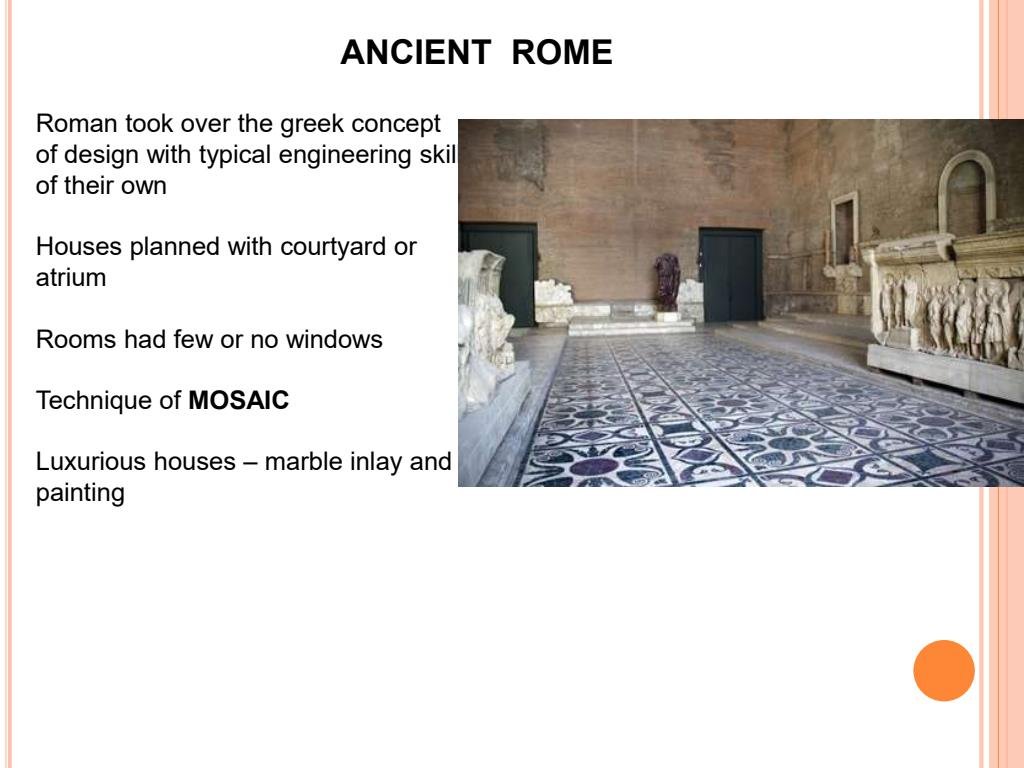
Roman innovations in planning and decoration established foundations that would influence European interiors for centuries.
Medieval Interior Design
Following the decline of the Roman Empire, Europe entered the Middle Ages. Interior design reflected social instability, religious authority, and the need for protection. Churches, monasteries, castles, and fortified homes became central architectural forms.
Early Christian and Byzantine Influence
Early Christian and Byzantine interiors emphasized spirituality through architecture and decoration. Churches featured columns, arches, mosaics, stained glass, and religious imagery. Rich ornamentation served both aesthetic and symbolic purposes. Furniture ranged from simple household pieces to highly carved ecclesiastical furnishings.
Romanesque Interiors
Romanesque spaces were characterized by heavy stone construction, thick walls, and relatively dark interiors. Decorative carving, painted surfaces, and sculptural details appeared throughout churches and noble residences. Furniture included chests, benches, stools, tables, and carved bedsteads.
Gothic Interiors
The Gothic period introduced greater decorative complexity. Interiors featured pointed arches, stained glass, ornate carvings, tapestries, and symbolic motifs such as lions and griffins. New furniture forms emerged, including armoires, four-poster beds, and specialized storage pieces. Rich textiles and decorative craftsmanship transformed interiors into expressive environments.
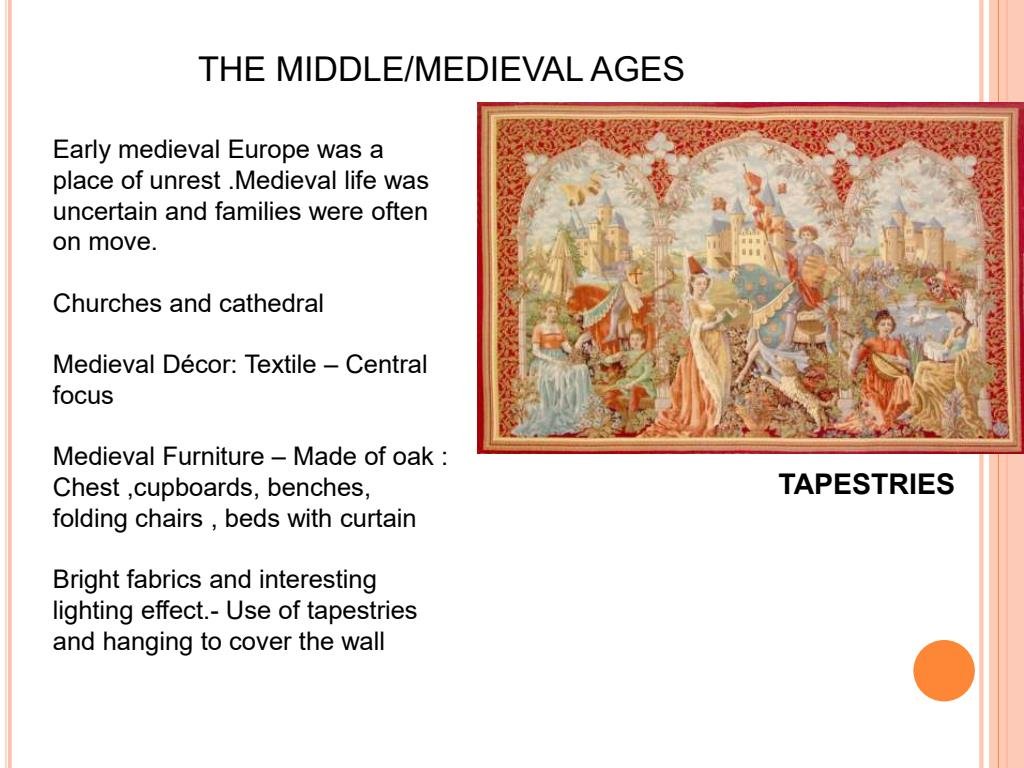
The medieval era demonstrated how interior design could shape emotional and spiritual experiences through light, color, and symbolic decoration.
Renaissance Interior Design
The Renaissance marked one of the most influential periods in the history of interior design. Inspired by classical Greek and Roman ideals, designers focused on symmetry, proportion, artistic excellence, and human-centered environments.
Early Renaissance
Italian Renaissance interiors incorporated frescoed walls, carved ceilings, marble flooring, classical details, and balanced spatial planning. France emphasized luxury and decorative refinement. Germany explored floral motifs and woodwork, while England introduced more specialized rooms including parlors, closets, and private bedrooms.
High Renaissance
During the High Renaissance, interiors became increasingly sophisticated. Designers integrated classical architecture into wall treatments, moldings, fireplaces, windows, and ceilings. Fresco painting flourished, creating immersive decorative environments. Furniture became more varied and richly detailed.
The Renaissance established standards of elegance and spatial organization that continue to influence contemporary luxury interiors.
Baroque and Rococo Design
As Renaissance ideals evolved, designers pursued greater drama and ornamentation.
The Baroque Period
Baroque interiors emphasized grandeur, movement, and theatricality. According to the source, Baroque design featured dynamic forms, dramatic contrasts, sculptural furniture, monumental staircases, and richly decorated surfaces. Complex geometric forms replaced the strict symmetry of earlier periods.
Rooms became immersive experiences designed to impress visitors and display wealth and authority.
Rococo Style
The Rococo movement emerged in France as a lighter, more playful interpretation of Baroque design. Interiors featured pastel colors, asymmetrical compositions, mirrors, decorative wall treatments, shell motifs, and elegant furniture. Designers created highly refined environments that emphasized comfort, sociability, and visual delight.
The Rococo period illustrates how interior design can evolve from monumental grandeur toward intimate luxury and personal enjoyment.
Revival Styles and Colonial Influences
The eighteenth and nineteenth centuries witnessed renewed interest in historical styles. Colonial, Greek Revival, Gothic Revival, and Federal styles adapted classical traditions to modern contexts.
American interiors reflected a blend of European influences and local craftsmanship. Greek Revival interiors incorporated motifs inspired by classical architecture, while Gothic Revival emphasized pointed arches and medieval decorative forms. Federal style furnishings combined elegance with neoclassical influences.
These movements reveal how historical traditions were continuously reinterpreted to meet contemporary tastes.
The Industrial Era and Design Reform
The Industrial Revolution transformed every aspect of society, including interior design.
Mass production expanded access to furnishings and decorative objects. New manufacturing methods reduced costs and increased design possibilities. At the same time, some designers reacted against industrialization’s perceived loss of craftsmanship.
Art Nouveau
Art Nouveau celebrated organic forms inspired by nature. Designers used flowing lines, floral motifs, glass, steel, ceramics, and innovative decorative elements. The movement helped eliminate distinctions between fine art and decorative art, encouraging holistic interior environments.
Arts and Crafts Movement
The Arts and Crafts movement emphasized handmade quality, honesty in materials, and traditional craftsmanship. Furniture often used oak, maple, walnut, and mahogany. Strong colors, handcrafted lighting, decorative rugs, and visible construction details reflected a commitment to authenticity.
These movements laid the foundation for later modern design philosophies.
Modernism and Twentieth-Century Design
The twentieth century revolutionized interior design more dramatically than any previous period.
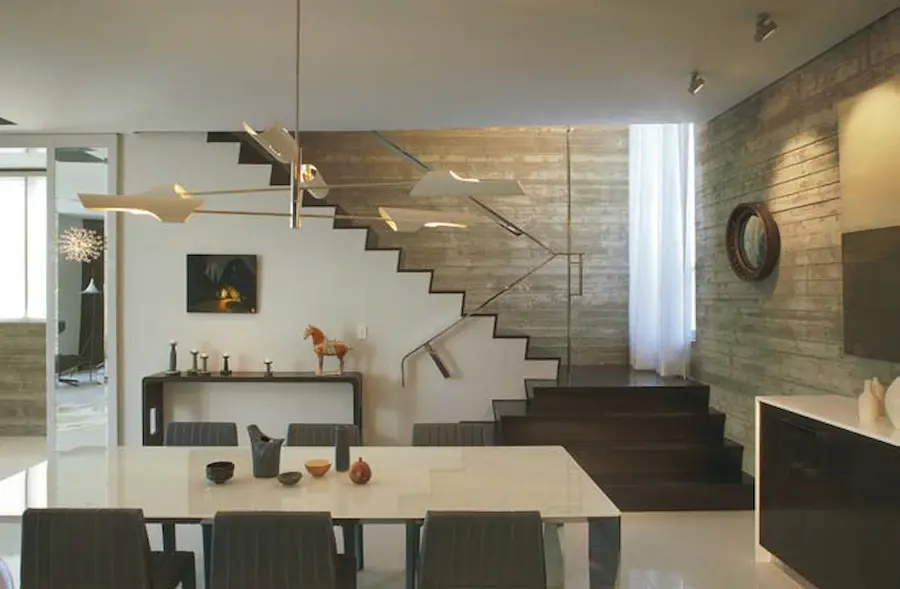
A contemporary residence in Venice, California (2009), contrasting rough-textured concrete walls with refined wood, steel, and terrazzo finishes in the history of interior design.Eclecticism
Early twentieth-century designers often combined historical influences from multiple traditions. This approach allowed designers to draw inspiration from various cultures and styles while creating unique environments. The period also witnessed the emergence of interior decoration as a recognized profession.
Bauhaus
The Bauhaus movement championed simplicity, functionality, and industrial production. Interiors typically featured neutral colors, glass, steel, concrete, and minimal ornamentation. Designers focused on efficiency and modern living requirements.
De Stijl
De Stijl embraced geometric abstraction, primary colors, and strict visual order. Furniture and interiors became artistic expressions of balance and clarity.
Mies van der Rohe
Mies van der Rohe promoted the principle “less is more.” His designs employed steel, glass, open plans, and precisely crafted furniture. His work demonstrated how minimalism could achieve elegance and sophistication simultaneously.
Le Corbusier
Le Corbusier developed interiors based on modular systems, mathematical proportions, functional furniture, and modern geometry. His work influenced both residential and commercial design worldwide.
Art Deco
Art Deco introduced streamlined geometry, luxury materials, mirrors, chrome finishes, curved furniture forms, and bold decorative statements. It represented optimism, industrial progress, and modern elegance.
International Style
The International Style advanced functionalism through clean lines, open spaces, modern materials, and simplicity. Decoration was minimized in favor of architectural clarity and efficiency.
Interior Design in the 21st Century: The Rise of Artificial Intelligence
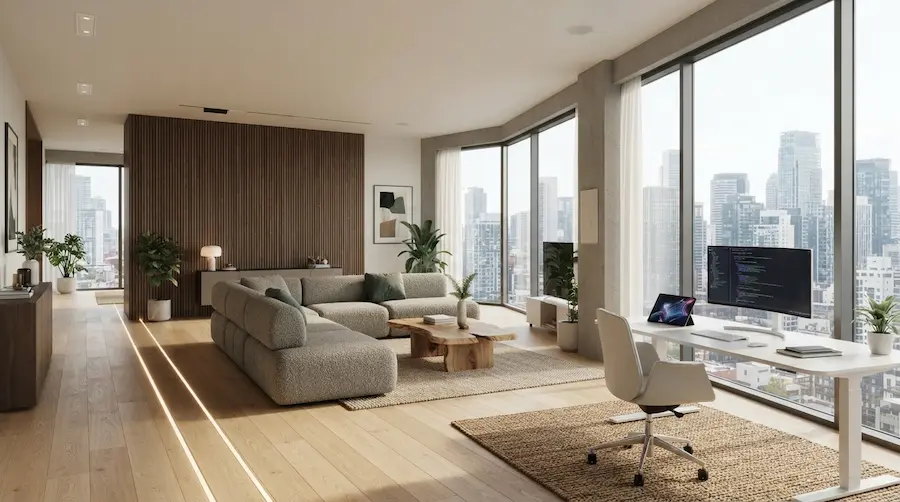
The History of Interior Design has always been closely connected to technological progress. From the handcrafted furniture of ancient civilizations to the industrial innovations of the twentieth century, each era introduced new tools that transformed the way people conceived and organized interior spaces. In the twenty-first century, Artificial Intelligence (AI) has emerged as one of the most influential innovations shaping the next chapter in the Evolution of Interior Design. Contemporary design increasingly combines human creativity with data-driven technologies, allowing designers to create environments that are more efficient, personalized, sustainable, and responsive to occupants’ needs.
This technological shift represents a natural continuation of the historical relationship between design and innovation that has characterized Interior Design History across centuries. According to recent research, contemporary interior design trends are increasingly influenced by technology, sustainability, and changing lifestyles, demonstrating how technological advancements continue to redefine design practices.
Unlike traditional design methods, AI-powered tools can analyze vast amounts of information within seconds. Designers can use machine-learning algorithms to evaluate user preferences, spatial dimensions, lighting conditions, circulation patterns, and furniture arrangements before making design decisions. This capability significantly reduces planning time while improving design accuracy. As a result, Contemporary Interior Design is becoming more user-centered, offering customized solutions that reflect individual lifestyles and functional requirements. The integration of technology into design processes also aligns with the broader historical pattern identified by scholars, who emphasize that technological innovations have consistently influenced the development of interior environments throughout history.
AI is particularly valuable in small apartments, studios, and urban residences where efficient space utilization is critical. Advanced software can generate multiple layout alternatives, simulate daylight performance, recommend color schemes, and optimize furniture placement according to specific objectives. These capabilities help designers achieve a balance between aesthetics and functionality, a principle that has remained central throughout the History of Interior Design. Moreover, AI-assisted visualization technologies enable clients to experience realistic digital representations of proposed spaces before construction begins, reducing uncertainty and improving decision-making.
Another significant contribution of AI involves sustainability. Modern design practice increasingly prioritizes energy efficiency, environmental responsibility, and resource conservation. Contemporary research highlights sustainability as one of the defining characteristics of twenty-first-century design. AI systems can analyze material performance, estimate environmental impacts, and recommend eco-friendly alternatives that support sustainable design goals. Consequently, Modern Interior Design no longer focuses solely on appearance but also considers long-term environmental performance and occupant well-being.
Artificial Intelligence is also transforming professional workflows. Designers can now automate repetitive tasks such as drafting, rendering, material selection, and project documentation. Rather than replacing creativity, AI functions as a collaborative tool that enables professionals to dedicate more time to conceptual development, innovation, and human-centered design solutions. This partnership between human imagination and digital intelligence reflects the ongoing evolution of Interior Design Styles, where technological capabilities continuously expand creative possibilities.
Ultimately, the twenty-first century represents a new milestone in the Evolution of Interior Design. Just as Ancient Interior Design, Renaissance creativity, and twentieth-century modernism reflected the cultural and technological conditions of their time, AI is becoming a defining element of contemporary practice. As technology continues to advance, the future of Contemporary Interior Design will likely be characterized by intelligent environments, adaptive spaces, predictive design systems, and increasingly personalized user experiences. In this sense, Artificial Intelligence is not a departure from the History of Interior Design but rather the latest stage in its ongoing transformation, bridging historical knowledge with future innovation.
Contemporary and Future Directions
Modern interior design continues to evolve through a combination of historical influences, technological innovation, and sustainability concerns.
Postmodern Design
Postmodernism emerged as a reaction against strict modernist principles. Designers embraced historical references, eclectic combinations, humor, symbolism, and greater visual diversity. The objective was to create spaces that engaged both emotional and intellectual experiences.
High-Tech Design
High-tech interiors incorporate industrial materials, technological systems, and visible structural elements. Inspired by technological advancement, this style transforms functional components into aesthetic features.
Today, contemporary interiors blend minimalism, sustainability, smart-home technology, wellness-oriented design, and historical inspiration. Rather than following a single style, modern designers often create personalized environments adapted to individual lifestyles.
Conclusion
The history of interior design reflects humanity’s continuous effort to improve the quality of life through space. From Mesopotamian courtyards and Egyptian furnishings to Gothic cathedrals, Renaissance palaces, Bauhaus simplicity, and contemporary smart homes, every era contributed ideas that continue to shape modern interiors.
Understanding the evolution of interior design helps us appreciate that today’s interiors are not isolated creations but the result of thousands of years of experimentation, cultural exchange, artistic innovation, and technological advancement. As society continues to evolve, interior design will remain a powerful tool for balancing beauty, functionality, comfort, and human well-being.
References
Pile, J., & Gura, J. (2014). History of interior design (4th ed.). John Wiley & Sons.