

Introduction
If you live in a studio apartment or a compact city condo, you already know the struggle: limited floor space, cluttered corners, and closets that never feel quite large enough. The traditional solution? Buy fewer things. The smarter solution? Build upward.
That’s where the AI Bedroom Vertical Storage Plan changes everything.
Instead of guessing where shelves should go or overloading walls with random racks, today’s AI-powered tools analyze your room’s exact dimensions and generate a data-driven vertical layout. It’s efficient. It’s aesthetic. And it’s redefining modern smart living.
Let’s break down how it works — and how you can apply it.
The Tech Advantage Behind an AI Bedroom Vertical Storage Plan
Traditional shelving relies on measuring tapes and intuition. An AI Bedroom Vertical Storage Plan, on the other hand, uses data.
In 2026, AI interior platforms combine:
- LiDAR-based 3D spatial scanning
- Depth-mapping cameras
- AI layout optimization algorithms
- Real-time visualization engines
Many newer smartphones and tablets now include LiDAR sensors capable of scanning wall height, ceiling clearance, window placement, and furniture footprint within seconds.
Why This Matters
AI eliminates:
- Uneven shelf spacing
- Blocked light sources
- Overloaded wall sections
- Awkward visual imbalance
Instead of eyeballing measurements, AI systems calculate:
- Optimal vertical distribution
- Weight-bearing zones
- Clearance for doors and windows
- Lighting interaction with shelving
The result? A precise, proportional vertical strategy tailored to your bedroom — not a generic Pinterest guess.
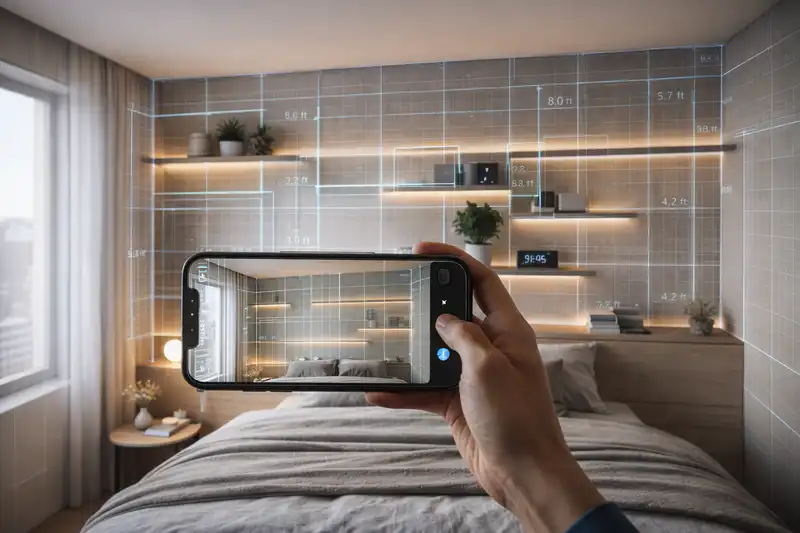
How the AI Bedroom Vertical Storage Plan Replaces Guesswork
AI doesn’t just measure — it optimizes.
Once your space is scanned, algorithms analyze:
- Wall height-to-width ratio
- Dead vertical zones above doors and beds
- Natural light direction
- Human reach ergonomics
This ensures shelves aren’t just “installed.” They’re strategically positioned for both function and visual harmony.
It’s the same philosophy we discussed in our guide on [AI for Home Design], where AI transitions from inspiration tool to execution partner.
The 3-Step Execution of an AI Bedroom Vertical Storage Plan
The workflow is surprisingly simple. You don’t need to be an architect — just strategic.
Step 1: Scan
Use a LiDAR-enabled device or AI room-planning app.
- Capture all four walls
- Include ceiling height
- Scan existing furniture
The AI builds a digital twin of your bedroom.
Step 2: Generate
Input your priorities:
- “Maximize book storage”
- “Add hidden tech zone”
- “Create minimalist look”
- “Avoid blocking natural light”
The AI then produces a vertical layout proposal — often multiple versions ranked by efficiency.
Step 3: Visualize
Before drilling a single hole, you can:
- Rotate 3D mockups
- Test different materials
- Simulate lighting
- Adjust spacing
You’re no longer reacting to mistakes — you’re previewing success.
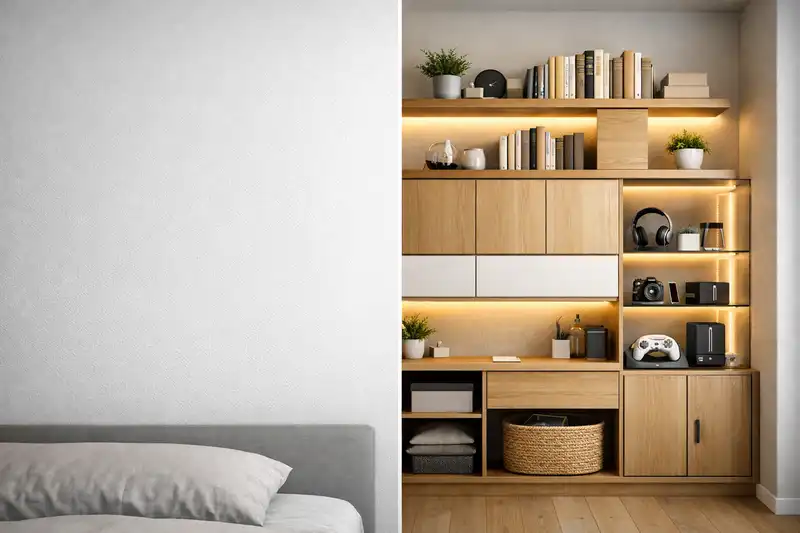
Top 3 Vertical Hacks in a Modern AI Bedroom Vertical Storage Plan
Let’s move from theory to real-world upgrades.
1️⃣ Smart Modular Vertical Units
AI often recommends modular wall systems because they:
- Adapt over time
- Distribute weight evenly
- Maintain visual symmetry
Look for:
- Slim-profile brackets
- Integrated cable channels
- Hidden mounting systems
These are currently trending across major platforms because renters want scalable solutions without permanent renovation.
2️⃣ Motorized Ceiling Racks
Yes — the ceiling.
AI frequently identifies overhead clearance as unused prime space. Motorized racks can:
- Lower when needed
- Lift storage above eye level
- Store seasonal items
This is vertical living at its most futuristic — and surprisingly practical.
3️⃣ AI-Optimized Wall Grids
Wall grids (pegboard-style or metal modular panels) are no longer DIY workshop tools.
In a modern AI Bedroom Vertical Storage Plan, they become:
- Tech charging hubs
- Headphone mounts
- Floating nightstand replacements
- Smart lighting anchors
The AI determines ideal spacing to avoid clutter and maintain minimalist balance.
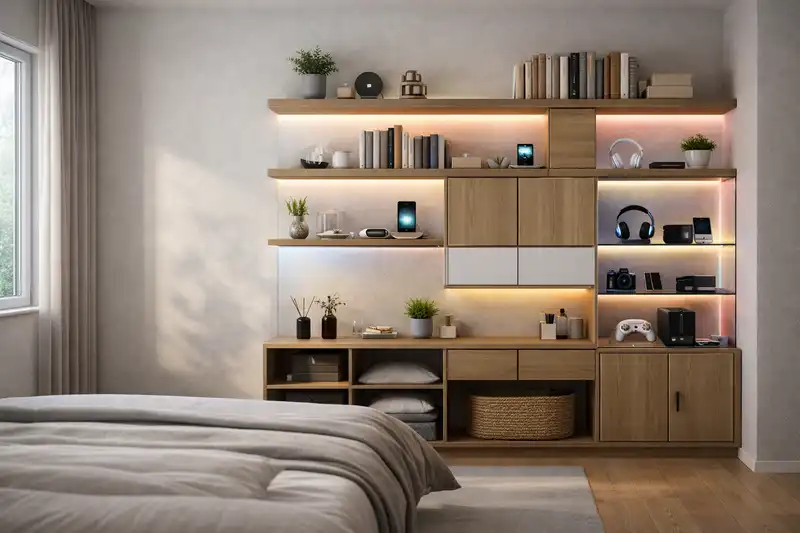
Why 2026 Is the Year of Vertical Intelligence
According to recent , space optimization has become the primary focus for city dwellers. Urban housing trends in 2026 are clear:
- Smaller footprints: Apartments are getting more compact.
- Higher rent: Maximizing every square inch is now a financial necessity.
- Greater demand for multifunctional design: Rooms must serve multiple purposes.
The AI Bedroom Vertical Storage Plan reflects a broader shift toward intelligent spatial optimization.
It’s not about adding more furniture.
It’s about adding more strategy.
The Haliskay Verdict
In 2026, designing a small bedroom without AI is like navigating without GPS.
An AI Bedroom Vertical Storage Plan delivers:
- Data-driven efficiency
- Elevated aesthetics
- Clutter reduction
- Long-term adaptability
For smart living enthusiasts and urban minimalists, vertical design is no longer optional — it’s essential.
And with AI handling the measurements, optimization, and visualization, you can focus on what truly matters: creating a bedroom that feels bigger, calmer, and intelligently designed. If you’re ready to expand this smart approach to the rest of your living space, don’t miss our comprehensive guide on [AI for Home Design] to see how AI is reshaping modern living.
Because in small spaces, every inch counts — especially the ones above eye level.
Ready to take your vertical storage beyond the bedroom? Explore our comprehensive breakdown of AI-driven space optimization layouts for modern living.