
Introduction: The 2026 Revolution in Pest Control
In 2026, Smart Mosquito Defense is no longer a futuristic concept—it is rapidly becoming the dominant model for household pest protection. Market analysts estimate the global mosquito control market will reach $37.95 billion by 2033, driven largely by innovations in automation, wearable technology, and AI-driven environmental sensing.
For residents of small urban apartments, traditional mosquito solutions are increasingly ineffective. Chemical sprays, coils, and scented repellents often create secondary problems:
- Poor indoor air quality
- Residue on furniture and fabrics
- Limited effectiveness in compact, enclosed living environments
These shortcomings have accelerated the shift toward Smart Mosquito Defense systems—solutions that prioritize precision targeting, automation, and scent-free operation.
Rather than saturating a room with chemicals, modern Smart Mosquito Defense technologies rely on ultrasonic frequencies, sensor-driven repellents, and rechargeable smart devices that protect specific living zones. For urban residents seeking Small Space Pest Control, these technologies represent a major breakthrough in both comfort and safety.
1. The Rise of Wearable Tech in Smart Mosquito Defense
One of the most fascinating developments in Smart Mosquito Defense is the emergence of wearable pest-repellent technology.
The Ultrasonic Mosquito Repellent Watch represents a new category of personal protection. Instead of treating a room, the device protects the individual wearer through dynamic ultrasonic frequency emission.
How AI Enhances Ultrasonic Repellent Technology
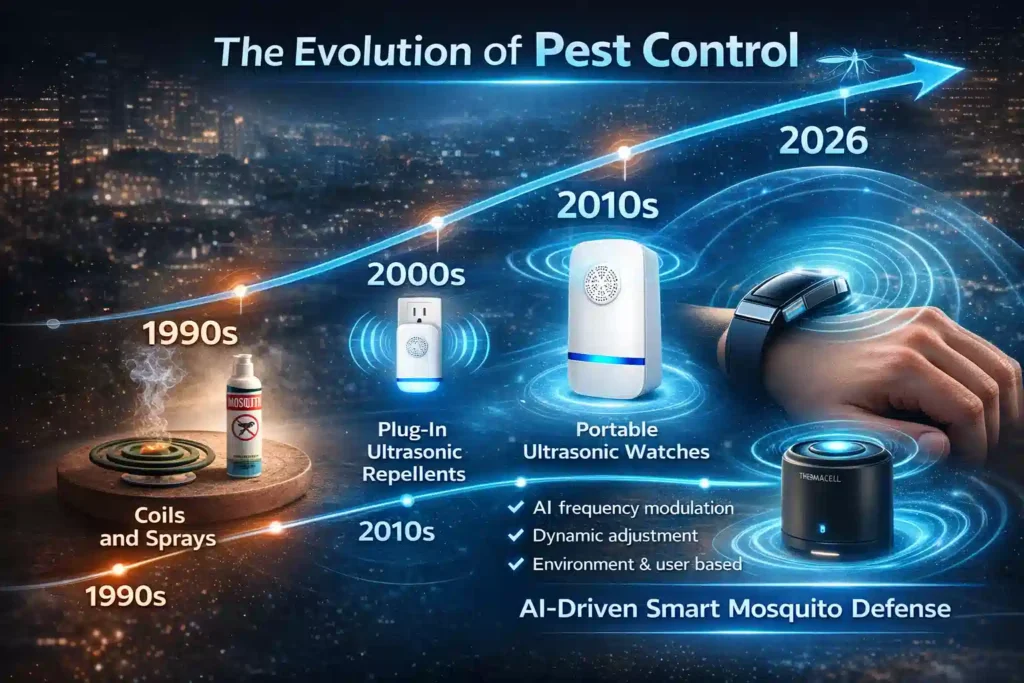
Traditional ultrasonic repellents operate at fixed frequencies, which mosquitoes may gradually adapt to. AI-driven wearable repellents solve this problem through adaptive frequency modulation.
Modern systems incorporate:
- AI-driven frequency adjustments
- Real-time environmental sensing
- Dynamic signal variation
This means the device constantly shifts between frequencies, preventing mosquitoes from adapting.
For travelers, hikers, and urban commuters, wearable devices are becoming a cornerstone of Smart Mosquito Defense, offering portable and chemical-free protection.
2. Top Pick for Indoor Automation: FTOTL 2026 Ultrasonic Repeller
For homeowners seeking automated Smart Mosquito Defense, plug-in ultrasonic repellers remain among the most practical solutions for apartments and small living spaces.
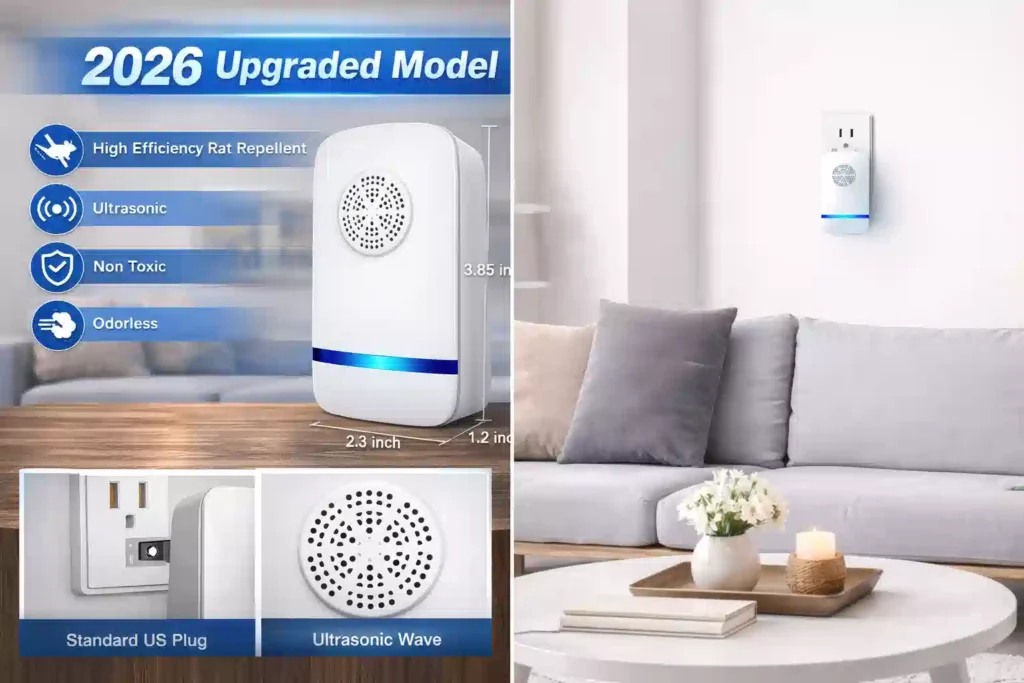
The FTOTL 2026 Upgrade Ultrasonic Repeller is one of the most widely adopted options for Indoor Small Space Defense.
Why It Stands Out
Unlike many older repellers, the FTOTL system is designed specifically for continuous indoor operation.
Key Specifications
- Package: 6-Pack Plug-in System
- Coverage: 80–120 square meters per unit
- Power Source: Standard electrical outlet
- Noise Profile: Silent ultrasonic emission
- Safety: Safe for children and pets
- Maintenance: No chemicals or cartridges
These features make it an ideal foundation for Smart Mosquito Defense in apartments, studios, dorms, and compact homes.
Because each unit covers a defined zone, users can strategically place them throughout:
- Bedrooms
- Living rooms
- Kitchens
- Entryways
This modular approach allows residents to build a layered Smart Mosquito Defense system without introducing pesticides into their living environment.
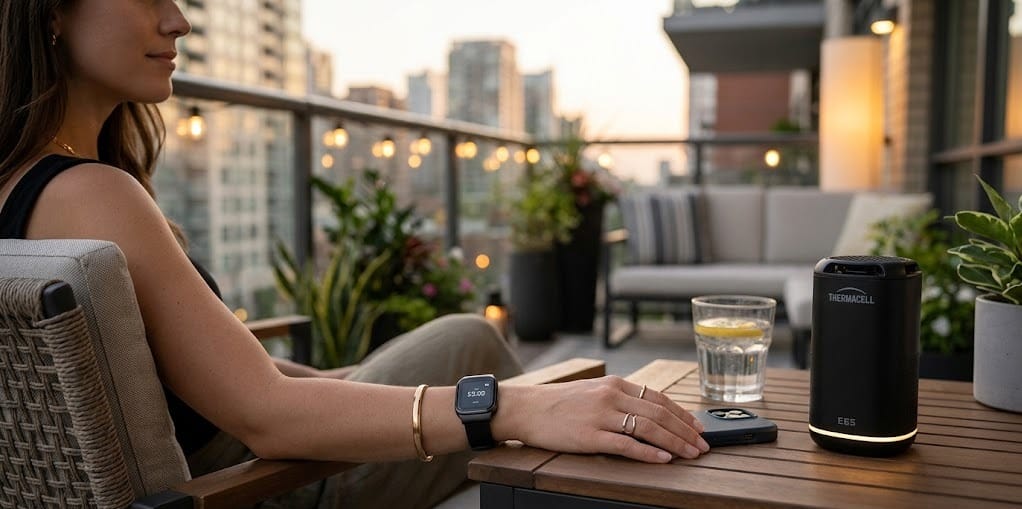
3. The Gold Standard for Outdoor Protection: Thermacell E-Series EX90
While ultrasonic devices excel indoors, patios and balconies require a different category of Smart Mosquito Defense.
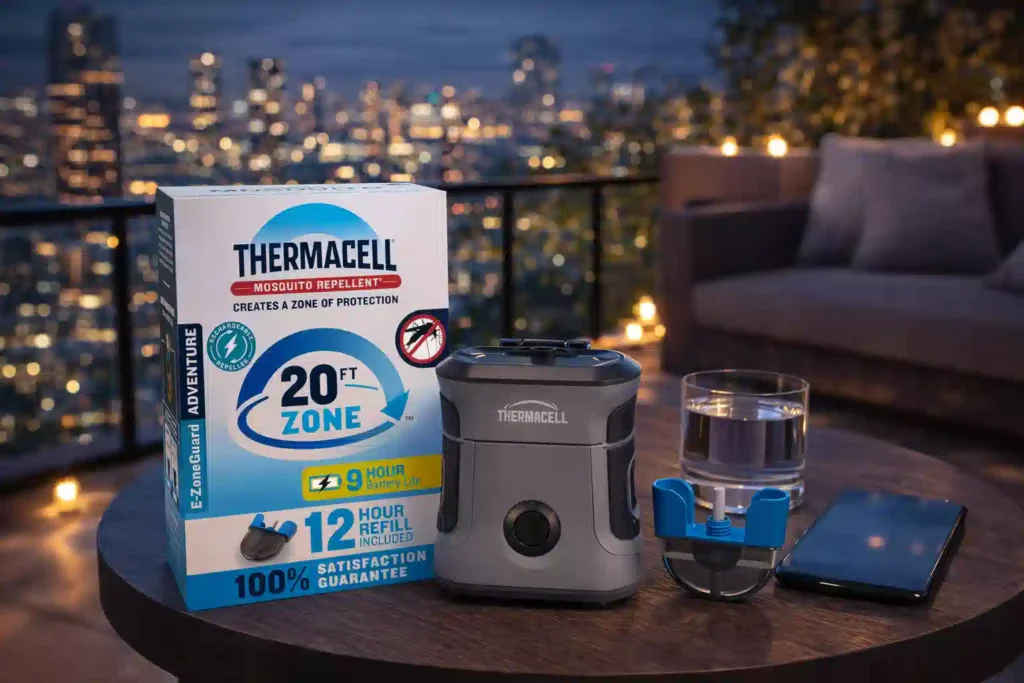
This is where the Thermacell E-Series becomes a leading solution.
Unlike sprays or candles, Thermacell devices create a localized protection zone, effectively forming an invisible shield around the user.
Thermacell E-Series Key Features
- Protection Zone: 20-foot mosquito defense area
- Battery Life: 6.5 to 9 hours per charge
- Operation: Scent-free and smoke-free
- Technology: EPA-reviewed repellent system
- Portability: Lightweight rechargeable design
For urban balconies or small patios, this system represents one of the most reliable forms of Smart Mosquito Defense currently available.
Comparing Thermacell Models
Two popular variations serve slightly different user profiles.
Thermacell E65 / Thermacell E90
Best suited for:
- Apartment balconies
- Outdoor dining areas
- Compact patios
Thermacell Adventure EX-Series EX90
Designed for:
- Hiking and camping
- Outdoor travel
- Rugged environments
Meanwhile, the Thermacell Patio Shield is tailored specifically for casual urban outdoor use, making it ideal for balcony seating areas.
4. Data-Driven Verdict: Style vs. Substance in Smart Mosquito Defense
With the mosquito control industry expanding at a 15.37% CAGR, consumers are increasingly demanding solutions that balance technology, convenience, and effectiveness.
From a strategic standpoint, the most effective Smart Mosquito Defense approach is multi-layered protection.
Best Use Cases
Wearable Devices (Ultrasonic Watches)
Best for:
- Travel
- Hiking
- Outdoor commuting
- Personal mobility
Plug-in Ultrasonic Repellers
Best for:
- Bedrooms
- Living rooms
- Small apartments
- Continuous indoor protection
Thermacell Systems
Best for:
- Patios
- Balconies
- Outdoor seating areas
- Camping trips
Combining these technologies allows homeowners to construct a comprehensive Smart Mosquito Defense ecosystem that adapts to different environments.
5. Comparison table
| Feature | Ultrasonic Repellent Watch | FTOTL 2026 Plug-in | Thermacell E-Series (E65/EX90) |
| Best Use Case | Personal Mobility & Travel | Indoor Whole-Home Coverage | Patios, Balconies & Outdoor Seating |
| Primary Technology | AI-Driven Ultrasonic Waves | High-Frequency Sonic Pulse | Heated Scent-Free Repellent |
| Protection Zone | Individual Wearable Shield | 80 – 120 sq. meters (per unit) | 20-Foot Radius Protection Zone |
| Power Source | Built-in Rechargeable Battery | AC Wall Outlet (Continuous) | Rechargeable Lithium-Ion Battery |
| Environment | Indoor / Outdoor (Personal) | Indoor Use Only | Outdoor Use Only |
| Safety Standard | Chemical-Free & Non-Toxic | Safe for Children & Pets | EPA-Reviewed & DEET-Free |
| Key Smart Feature | Adaptive Frequency Modulation | 24/7 Automated Protection | Battery Status & LED Indicators |
6. The Future of Protection: Why 2026 Tech is Different
Mosquito control in the U.S. has come a long way since the first organized programs of the early 1900s. Traditionally, community-level protection relied on Integrated Pest Management (IPM)—a multifaceted strategy involving aerial surveillance, habitat modification, and the precise application of EPA-registered larvicides. While these government-led programs remain the backbone of public health, the burden of protection is shifting toward a more personalized, Smart Mosquito Defense model. +1
In 2026, the technology is fundamentally different because it bridges the gap between massive “space sprays” and individual needs. Here is why this era marks a turning point:
- From Mass Spraying to Precision AI: Traditional programs involve truck-mounted or aerial spraying that must coincide with specific wind and temperature conditions to be effective. In contrast, the new generation of Ultrasonic Mosquito Repellent Watches uses AI-enabled algorithms to learn user habits and environmental patterns, optimizing frequency emissions in real-time.
- Biometric & Environmental Sensing: Unlike the static methods of the past, 2026 wearables are being integrated with biometric sensors (monitoring heart rate and skin temperature) and environmental sensors (detecting humidity and mosquito density). This data feeds into a Smart Mosquito Defense ecosystem, providing a level of predictive pest management that early 20th-century officials could only dream of.
- The “Smarter” IPM Approach: The EPA and CDC have long encouraged “source reduction”—eliminating standing water and breeding grounds. Modern tech supports this by integrating with smart home ecosystems, alerting residents to environmental conditions that favor mosquito breeding before an infestation occurs.
- Eco-Friendly Sustainability: While traditional chemical controls are effective and EPA-reviewed for safety, the current trend favors non-residual, chemical-free alternatives. The digital transformation of the market ensures that your Smart Mosquito Defense is not only effective but also aligns with the modern American lifestyle of sustainability and health consciousness.
As public education continues to be a pillar of effectiveness, the “informed resident” of 2026 is no longer just emptying flower pots—they are wearing the most advanced AI defense on their wrist.
Conclusion: The Future of Smart Mosquito Defense Is Scent-Free and Intelligent
The era of chemical-heavy mosquito control is rapidly fading. As urban living spaces become smaller and environmental awareness increases, consumers are gravitating toward automated, scent-free, and AI-driven solutions.
Modern Smart Mosquito Defense technologies—from ultrasonic wearables to rechargeable zone protectors—demonstrate that effective pest control no longer requires sprays, coils, or harsh chemicals.
Instead, the future belongs to precision protection systems that intelligently adapt to human environments.
For homeowners, travelers, and apartment residents alike, investing in Smart Mosquito Defense today is not just a convenience—it is a practical step toward future-proofing the modern smart home.