
Introduction: From Renovation Chaos to AI-Powered Home Planning
Not long ago, redesigning a house meant hiring a designer, buying stacks of catalogues, and hoping your vision matched reality. Today, AI for home design is changing that process completely.
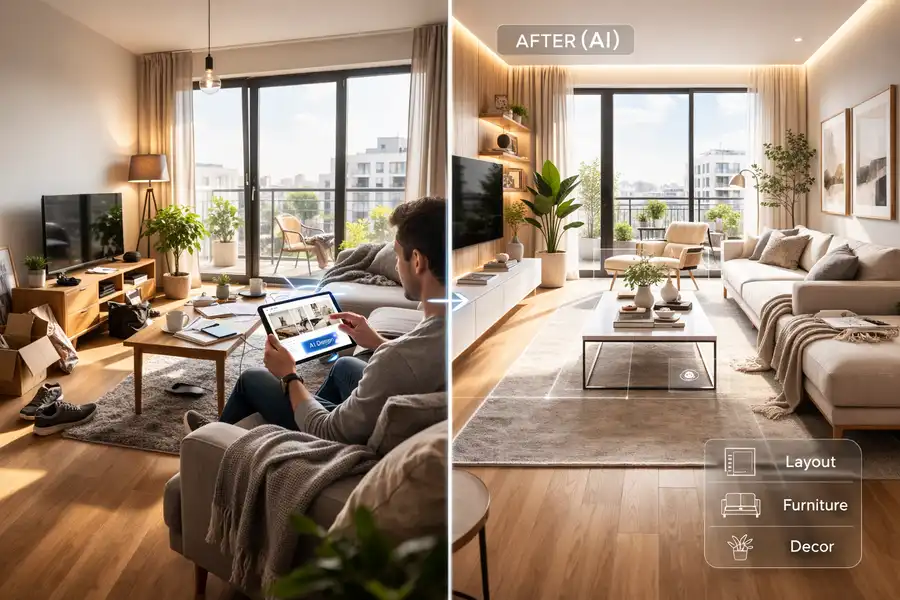
Instead of guessing how a new sofa or wall colour will look, homeowners and renters can now visualise full transformations in minutes. This shift toward AI-powered home planning makes modern interiors more accessible, affordable, and flexible—whether you live in a compact flat or a spacious family house why learning how to use AI for home design is becoming a essential skill for modern homeowners.
1. Benefits of Using AI for Home Design
- Space Optimisation for Small Apartments
If you live in a one-bedroom or studio apartment, every inch matters. AI tools can:
- Suggest smarter furniture layouts
- Visualise built-in storage solutions
- Recommend compact, multi-functional pieces
- Show how lighter colours can make rooms feel larger
When you redesign an apartment with AI, you quickly see which layouts free up walking space and which ones create clutter. That kind of instant feedback is invaluable in smaller homes.
- Style Matching for Larger Houses For bigger houses, the challenge is often consistency.
AI helps you:
- Maintain a cohesive style across multiple rooms
- Experiment with luxury finishes before committing
- Compare modern, classic, or transitional themes instantly
With AI house interior planning, you can test whether a bold kitchen design complements your living room without physically changing anything.
2. The Best AI for Home Design Tools
Here are some residential-focused AI tools worth exploring:
• Remodel AI Designed for realistic renovation previews. Upload a photo of your kitchen, bathroom, or living room, and generate modern redesign concepts tailored to real homes.
• Interior AI Especially useful for apartments. It allows you to transform a current room into various styles—minimalist, Scandinavian, industrial—within seconds.
These tools are practical rather than overly technical, making them ideal for everyday homeowners.
From Concept to Reality: How to Use AI Step by Step Here’s a simple way to get started:
Step 1: Take a Clear Photo Stand in a corner to capture the full room:
- Use natural lighting if possible.
- Avoid clutter so the AI can interpret the space correctly.
Step 2: Upload to an AI Tool Choose a platform like Remodel AI or Interior AI. Upload your image and select a style or renovation goal.
Step 3: Generate Variations Using AI for Home Design Don’t settle for the first result. Compare several options to see which layout and colour palette feel right.
Step 4: Evaluate Practicality Ask yourself:
- Does the furniture fit real-life dimensions?
- Is the walking space realistic?
- Does it match your budget?
Step 5: Implement Gradually Start with paint, lighting, or soft furnishings before committing to major purchases.
Using AI for home design works best when you treat it as a planning assistant—not a final blueprint.
Common Mistakes to Avoid AI is powerful, but it isn’t perfect. Keep these in mind:
Scale issues: AI may generate oversized furniture that wouldn’t actually fit.
Lighting inaccuracies: Artificial lighting can distort colours in real life.
Ignoring storage needs: Some AI designs prioritise aesthetics over practicality.
Over-editing: Constantly switching styles can make decision-making harder.
Always cross-check measurements before buying anything.
3. Refining the AI Vision: Why the Human Touch Matters
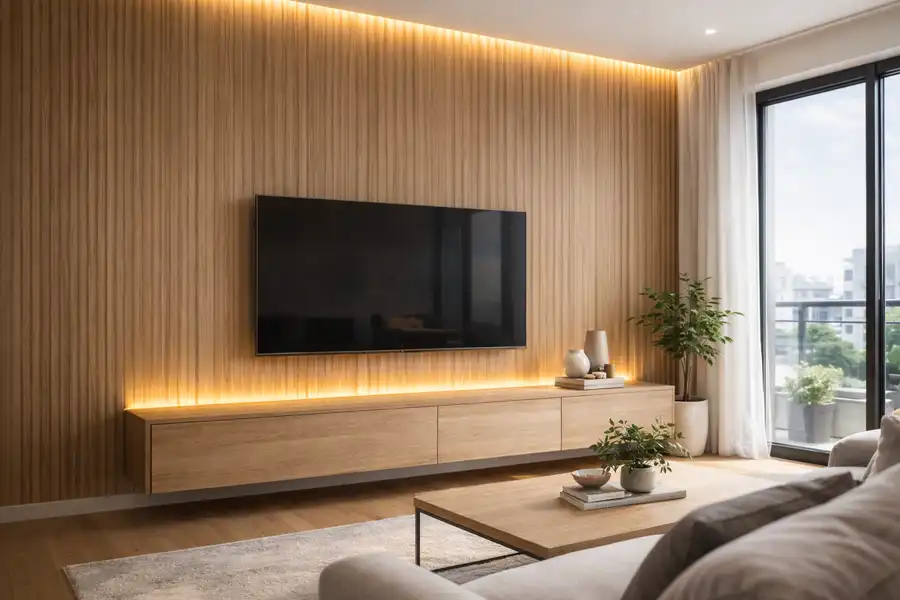
One of the most important lessons in using AI for interior design is knowing when to say ‘no.’ AI is brilliant at generating complex ideas, but it lacks the human intuition for simplicity and balance. For instance, in the following designs, you will notice that I intentionally deviated from the AI’s initial suggestions.
I decided to remove the extra shelving between the TV and the window, as I felt they cluttered the visual flow. By opting for a cleaner, more minimalist ‘Accent Wall,’ the space feels more open and sophisticated. This shows that while AI is your engine, you are always the pilot in control of the final aesthetic.
Conclusion:
Luxury Design, Now Within Reach AI tools are democratising interior design. What once required a large budget and professional support can now begin with a single photo and a few clicks.
Whether you want to redesign an apartment with AI or plan a full AI house interior makeover, these tools give you clarity before you spend money.
AI for home design doesn’t replace creativity—it enhances it. With the right approach, anyone can master AI for home design to create a stylish, functional home that feels professionally designed without the luxury price tag.